The invitation arrives, and before you even finish reading it your stomach tightens. Another dinner. Another overnight. Another round of “just this once.” You love these people, and you also feel stretched thin. If that sounds familiar, you are not selfish. You are ready for holiday boundaries that feel kind, clear, and free of the guilt spiral.
Thanksgiving falls on Thursday, November 26, this year, which means you still have time to decide what you can give and what you need to protect. Below you will find why boundaries matter, 10 ready-to-use scripts for common Thanksgiving moments, and gentle guidance for when the guilt shows up.
Why Holiday Boundaries Matter More Than You Think
Holiday stress is real. An American Psychological Association poll found that nearly nine in 10 U.S. adults say concerns such as money, missing loved ones, and anticipating family conflict cause them stress at this time of year, and about two in five said their stress increases compared with other points in the year.
Mayo Clinic experts are clear that setting healthy boundaries is necessary for your health and the health of your relationships, and that living within those boundaries is crucial to lowering stress. They also note that anxiety and stress develop when you take responsibility for others’ emotions, behaviors and thoughts. In other words, people-pleasing is not kindness. It is a boundary leak that drains you.
Mayo Clinic also reminds us to learn to say no, because saying yes when you should say no can leave you feeling resentful and overwhelmed. Friends and colleagues will understand if you cannot participate in every project or activity. The goal is not to shut people out. It is to show up as the version of you who still has energy left for joy.
If you want a deeper foundation for this work year-round, start with our guides on how to set boundaries and how to set boundaries with family. For the seasonal energy piece, pair this with how to avoid holiday burnout.
10 Gentle Holiday Boundary Scripts for Thanksgiving
Practice these out loud once or twice before the day. It can help to rehearse what you want to say, or even write it out first, so you can practice from a script. Keep your voice calm. You do not owe a speech. A short, honest sentence is enough.
1. Decline One Extra Event
APA research found that more than three-quarters of people have accepted an invitation they did not want to attend because they feared the fallout of saying no. The same research found that people consistently overestimate how upset the other person will be. Lead researcher Julian Givi notes that burnout is a real thing, especially around the holidays, and that it is okay to turn down invitations here and there. He also notes that time together is how relationships grow, so the goal is not to decline everything.
Script: “Thank you so much for thinking of me. I am keeping my calendar lighter this week, so I will sit this one out. I hope it is wonderful.”
2. Leave Early Without Making It a Scene
You can love the gathering and still have a bedtime. Mayo Clinic recommends being brief when you refuse a request and avoiding elaborate justifications. The same rule works when you leave. State the plan early so no one is surprised.
Script: “I am so glad to be here. Just a heads up that I need to head out by 7 so I can rest before tomorrow.”
3. Skip the Politics Debate
An APA survey conducted right before Thanksgiving 2024 found that nearly 2 in 5 U.S. adults said they are avoiding relatives they disagree with this holiday season, with even higher rates among younger adults. Psychologists told APA that people should feel empowered to make their own rules based on their needs, and that it is healthy to know when to stay in a conversation and when to exit.
Script: “I care about you, and I want today to stay peaceful. I am going to skip politics at the table. Want to help me with dessert instead?”
4. Protect Your Travel Recovery Day
If you flew in late Wednesday or drove for hours, Friday is not free labor. Mayo Clinic says saying no is not necessarily selfish. When you say no to a new commitment, you are honoring existing obligations, including the obligation to recover so you can be kind tomorrow.
Script: “I would love to help, and I need Friday morning to rest after travel. I can join for coffee after lunch if that works.”
5. Ask for Help in the Kitchen
APA stress guidance includes changing the situation when you can, perhaps by dropping some responsibility, relaxing your standards, or asking for help. You do not earn a gold star for carrying the whole meal alone.
Script: “I would love company in the kitchen. Can you take the salad and the drinks while I handle the turkey?”
6. Limit Overnight Stays
Hosting overnight guests can tip a cozy holiday into exhaustion. Mayo Clinic notes that always saying yes is not healthy, and that when you are overcommitted you are more likely to feel run-down. A hotel recommendation or a shorter visit can be a loving boundary.
Script: “We are so excited to see you for dinner. Our place is tight this year, so a nearby hotel will be more comfortable. I can send a couple of options.”
7. Protect Quiet Mornings
Mayo Clinic suggests making time for yourself, because spending just 15 minutes alone, without distractions, may refresh you enough to handle everything else. Guard that window before the day gets loud.
Script: “I am doing a quiet hour for myself in the morning. I will be ready to dive in at 10.”
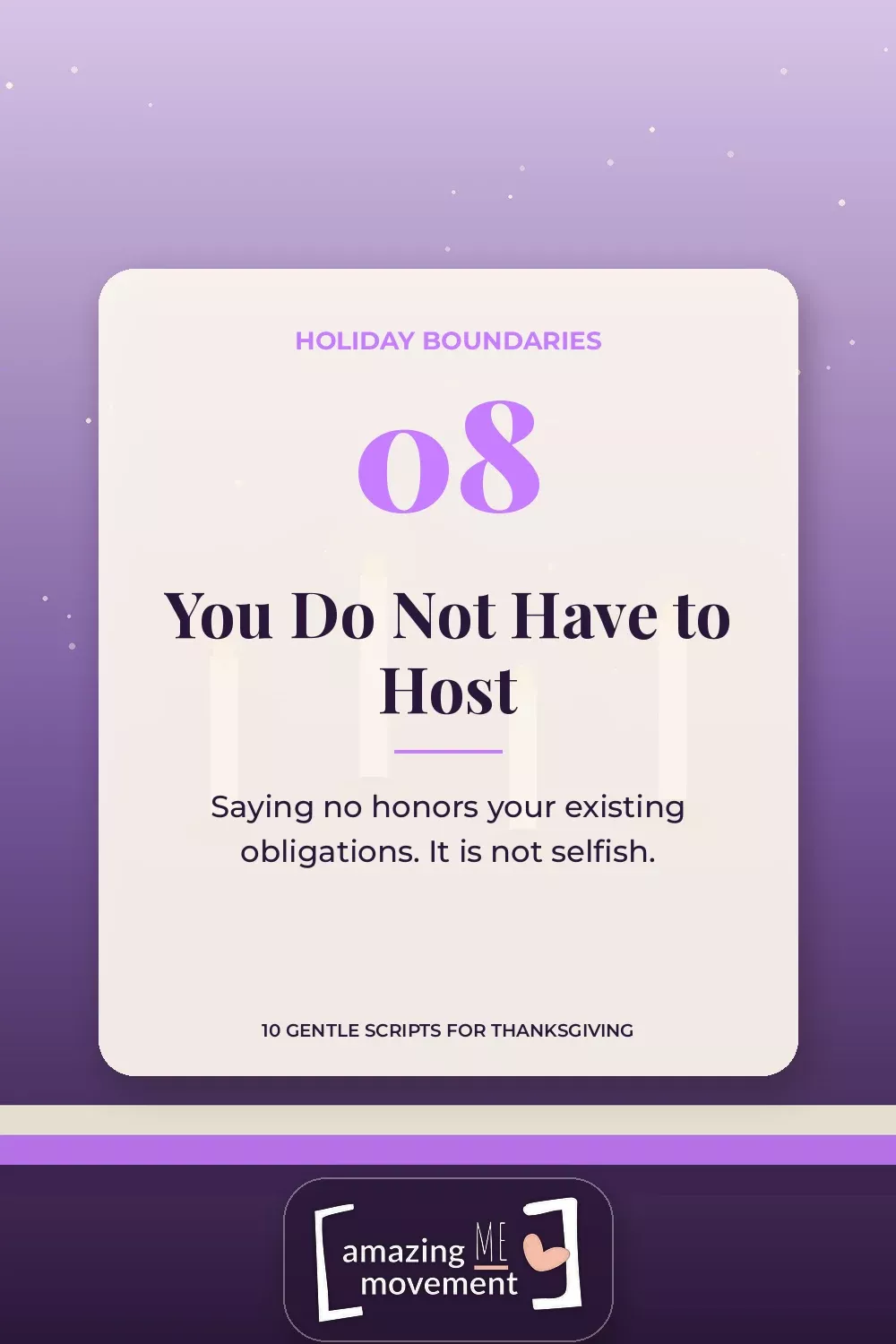
8. Decline Hosting This Year
If your body or budget says not this year, listen. Mayo Clinic is clear: do not agree to a request you would rather decline out of guilt or obligation, because that path leads to more stress and resentment. You can still contribute without carrying the whole house.
Script: “I cannot host Thanksgiving this year, and I still want to celebrate with you. I can bring two sides, or we can do a potluck at your place.”
9. Cap Gift Pressure and Budget Talk
APA found that financial concerns were the top holiday stressor, with 58 percent of adults saying spending too much or not having enough money causes stress. A clear gift agreement protects relationships from silent resentment.
Script: “I am keeping gifts simple this year with a $25 limit. Does that work for you too?”
10. End a Conversation That Crosses a Line
Comments about your body, career, relationship, or parenting are not required conversation. Mayo Clinic recommends practicing saying no in a firm, yet kind, way, and choosing not to keep talking with someone who will not respect your boundary. You can change the subject or leave the room.
Script: “I know you mean well, and I am not discussing that today. Tell me about your garden or the pie recipe instead.”
When the Guilt Shows Up
Guilt is often just a smoke alarm from an old people-pleasing habit, not proof that you did something wrong. Mayo Clinic explains that unhealthy boundaries are often driven by believing you cannot say no, and that valuing your no is part of growing healthier ones. APA research also shows that people tend to overestimate the negative fallout of declining an invitation.
Try this reset: put a hand on your chest, take one slow breath, and ask, “Is this guilt telling me I broke a value, or telling me I broke an old pattern?” If it is the pattern, thank it for trying to keep you safe, then keep your boundary anyway. For more practice with a soft no, read the art of saying no and signs of people-pleasing.
If the season still feels heavy, our holiday survival guide for introverts, Thanksgiving quotes, and quotes about slowing down can help you stay grounded between conversations.
When to Seek Support
Boundaries help, and they are not a cure-all. Mayo Clinic advises that if you feel persistently sad or anxious, plagued by physical complaints, unable to sleep, irritable and hopeless, and unable to face routine chores, and these feelings last for a while, you should talk to your health care provider or a mental health professional. APA likewise says that if you feel overwhelmed and self-help is not helping, look for a psychologist or other mental health provider.
If you are in the U.S. and need someone to talk to right now, you can call, text, or chat with the 988 Suicide & Crisis Lifeline anytime, day or night. Conversations are free and confidential. This article is for general information and encouragement and is not a substitute for professional mental health care.
Frequently Asked Questions
How do I set holiday boundaries without sounding rude?
Lead with appreciation, state the limit in one clear sentence, and offer a small alternative when it feels right. You do not need a long explanation. Warm plus brief usually lands better than soft plus endless apologizing.
What if my family pushes back?
Mayo Clinic says you may need to refuse a request several times before it sticks, so calmly repeat your no. You can also change the subject, take a breather outside, or leave early. Consistency teaches people what to expect from you.
Is it okay to skip Thanksgiving events for my mental health?
Yes, when an event would cost more peace than it gives. Choose thoughtfully rather than canceling everything. Stay connected in ways that feel safe, like a shorter visit, a phone call, or a Friendsgiving with people who respect your limits.
Your Turn: Which Script Will You Practice First?
Holiday boundaries are not walls. They are doors with locks you control. Pick one script from this list, say it out loud tonight, and let Thanksgiving be a day you enjoy instead of endure.
Which gentle script will you try first this Thanksgiving? Share it in the comments. Your words might give another woman the courage to protect her peace too.







Leave a Reply