Think of the person who believed in you before you believed in yourself. Maybe it was a teacher, a friend who showed up when life fell apart, or the manager who gave you your first real chance. Now ask yourself a gentle question: did you ever really tell them what they meant to you? If the answer is “not really,” this Thanksgiving is the perfect time to write a gratitude letter.
Thanksgiving falls on Thursday, November 26, this year, so you have a little over two weeks to put pen to paper. You do not need to be a writer or own fancy stationery. Below you will find what the research says, seven simple steps, prompts and a sample letter.
What Is a Gratitude Letter?
A gratitude letter is a thoughtful, specific thank you written to someone who made a real difference in your life. The Greater Good Science Center at UC Berkeley describes the Gratitude Letter practice as writing to someone “to whom you never expressed your deep gratitude,” and, if at all possible, delivering it in person. They suggest budgeting about 10 minutes for writing and at least 30 minutes for the visit.
If you love putting feelings into words, you may also enjoy our guide on how to write a heartfelt family love letter.
Why a Gratitude Letter Is Worth Ten Minutes of Your Day
This is not just a sweet idea. Harvard Health Publishing describes research by psychologist Martin Seligman, tested on 411 people, in which participants who wrote and personally delivered a letter of gratitude immediately exhibited a huge increase in happiness scores. That impact was greater than any other intervention tested, with benefits lasting for a month. Harvard also notes that studies like this one cannot prove cause and effect, but most studies on the topic support an association between gratitude and well-being.
The Greater Good Science Center adds that in that study, happiness had dropped back to where it started six months later, which is why some researchers suggest doing this exercise once every six weeks or so.
Gratitude letters may help even when you are going through a hard season. Researchers Joel Wong and Joshua Brown studied nearly 300 adults, mostly college students seeking mental health counseling. Compared with people who wrote about negative experiences or only received counseling, those who wrote gratitude letters reported significantly better mental health four weeks and 12 weeks after their writing exercise ended. Only 23 percent of the letter writers actually sent their letters, and the researchers say this suggests the benefits “are not entirely dependent on actually communicating that gratitude to another person.”
For more of the science, see our deep dive on the benefits of gratitude.
Why We Put It Off (And Why We Should Not)
Most of us hesitate because it feels awkward. A study published in Psychological Science by Amit Kumar and Nicholas Epley found that people who wrote gratitude letters significantly underestimated how surprised recipients would be about why they were grateful, overestimated how awkward recipients would feel and underestimated how positive recipients would feel.
The University of Chicago reports that while the letter writers worried about choosing the right words, the recipients were happy simply by the warmth of the gesture. As Kumar said in a UT News release, “it only takes a couple of minutes to compose letters like these, thoughtful ones and sincere ones.” Your imperfect words will land better than you expect.
How to Write a Gratitude Letter in 7 Simple Steps
These steps follow the Greater Good Science Center practice, with a few cozy Thanksgiving touches.
1. Choose Someone You Never Properly Thanked
Greater Good suggests calling to mind someone who did something for you that you are extremely grateful for but never fully thanked. This could be a relative, friend, teacher or colleague. Try to pick someone who is still alive and could meet you face to face in the next week. Your grandmother, your college roommate or the neighbor who helped during a crisis are all wonderful choices.
2. Start With “Dear” and Write Like You Are Talking to Them
Write as though you are speaking directly to this person. “Dear Aunt Linda” instantly feels warmer than a formal opening. Use their nickname and the inside joke. This is a letter, not a speech.
3. Be Specific About What They Did
This is the heart of a great gratitude letter. Greater Good recommends describing in specific terms what this person did, why you are grateful and how their behavior affected your life, being as concrete as possible. “Thanks for everything” is sweet. “Thank you for sitting with me the night I lost my job” is unforgettable.
4. Show the Ripple Effect
Connect the dots for them. How did their kindness change what happened next? Maybe the teacher who praised your essay is the reason you write for a living. People rarely get to see the ripple effects of their kindness. Your letter lets them.
5. Share Where You Are Now
Greater Good also suggests describing what you are doing in your life now and how you often remember their efforts. It tells them their kindness is still alive in your life today.
6. Let Go of Perfect
The Greater Good instructions say it plainly: do not worry about grammar or spelling. Recipients care about the warmth, not the wordsmithing. A slightly messy letter beats a polished one that never gets written.
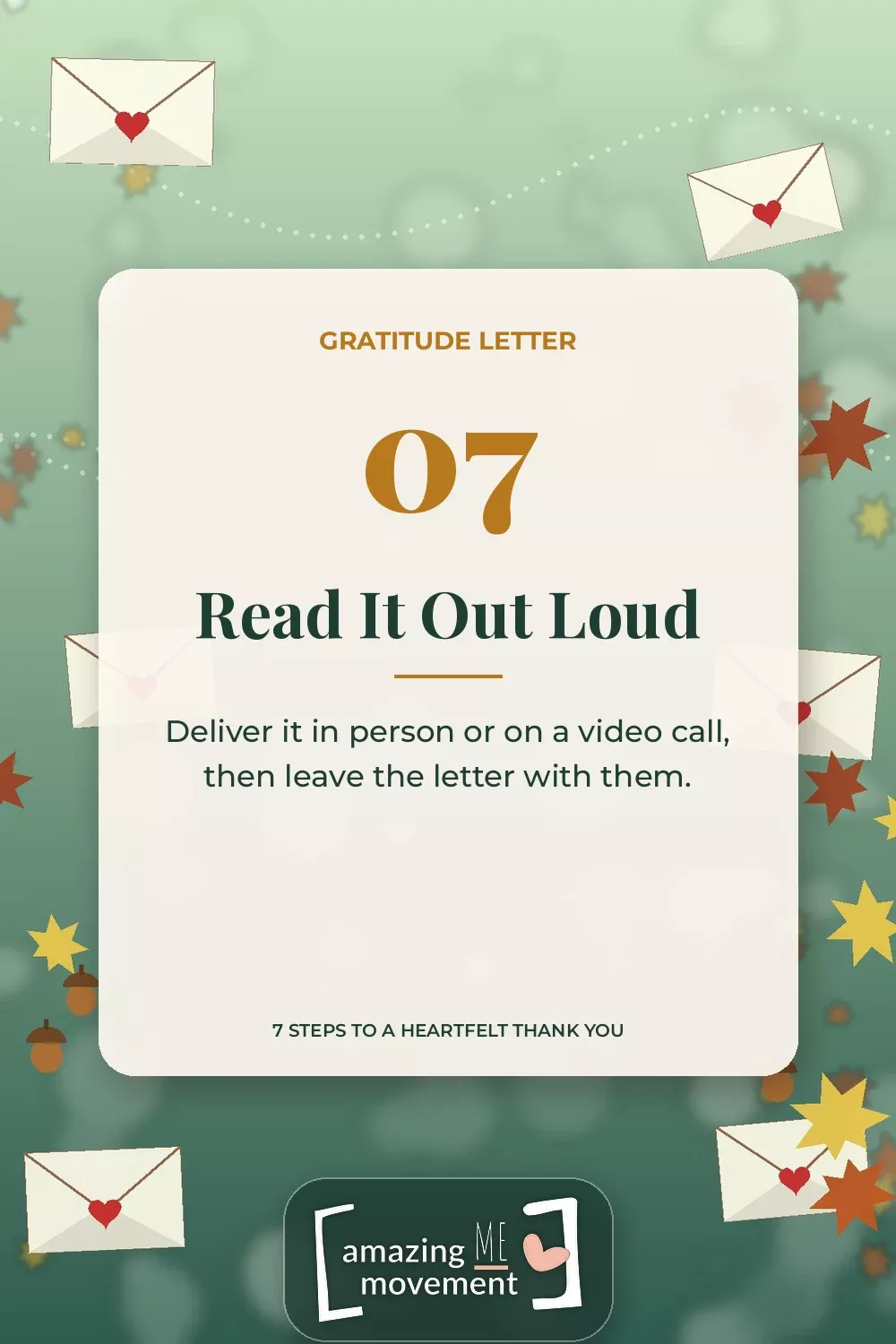
7. Deliver It and Read It Out Loud
This is the brave part. Greater Good notes that while there are benefits simply to writing the letter, you reap significantly greater benefits from delivering and reading it in person. Plan a visit, read the letter slowly, then talk about how you both feel. Remember to leave the letter with them. If distance keeps you apart, a phone or video call works too.
Gratitude Letter Prompts for Thanksgiving
Staring at a blank page? Finish one of these sentences and you are halfway there:
- “I still think about the time you…”
- “You probably do not know this, but because of you I…”
- “The thing I admire most about you is…”
- “When everything felt hard, you were the one who…”
- “Every Thanksgiving, I remember…”
- “I never said it properly, so here it is: thank you for…”
Need more inspiration? Browse our list of things to be grateful for, or borrow a line from our quotes about gratitude to open or close your letter.
A Short Gratitude Letter Example
Here is a made-up sample you can adapt. Notice how it names a specific moment, the ripple effect and where life is now:
Dear Coach Rivera,
In tenth grade, after I missed the free throw that lost us the championship, you found me crying in the locker room. You did not give me a speech. You just sat down and said, “One shot does not get to decide who you are.”
I have thought about that sentence before job interviews, after my divorce and on the day I opened my own small business. Today I say some version of your words to my own team whenever someone has a rough day.
You probably do not remember that afternoon, but I always will. Thank you for seeing me when I felt like a failure. This Thanksgiving, you are on my gratitude list, right at the top.
With love and thanks, Megan
Cozy Ways to Share Your Gratitude Letter This Thanksgiving
- Read it before the meal. If the person will be at your table, ask for five quiet minutes before dinner, just the two of you.
- Bring it to Friendsgiving. Friends who feel like family deserve thank yous too. Our Friendsgiving ideas include plenty of ways to make the moment cozy.
- Schedule a video call. Far away this year? Read it over a call, then mail the paper copy so they can keep it.
- Start a tradition. Write one letter every Thanksgiving, or try one every six weeks, as some researchers suggest.
Pair your letter with some of our favorite Thanksgiving quotes for a card that feels extra special.
When Gratitude Feels Complicated
It is okay if gratitude does not feel easy. Harvard Health notes some notable exceptions to the generally positive results in gratitude research. Greater Good also reports that in one study, Indian adults felt more guilty and indebted after writing gratitude letters than some other groups, so the practice may land differently depending on your culture and family.
If thinking about a certain person brings up pain, choose someone else. You never owe a letter to anyone who hurt you, and you can protect your peace this season with our guide to setting holiday boundaries without guilt. You can also write a letter just for yourself and never send it. Remember, most of the counseling study participants never mailed theirs.
If you are struggling with grief, loneliness or low mood this season, please reach out to your doctor or a licensed mental health professional. In the US, you can call or text 988 to reach the 988 Suicide & Crisis Lifeline anytime, day or night. It is free and confidential.
Gratitude Letter FAQ
How long should a gratitude letter be?
There is no rule. Greater Good suggests budgeting about 10 minutes to write, and many heartfelt letters fit on a single page. Focus on being specific rather than long.
Do I have to send my gratitude letter?
No. Delivering it in person may bring bigger benefits, according to Greater Good, but in the counseling study described above most writers did not send their letters and still saw benefits. Write it first and decide later.
Can I write a gratitude letter to someone who has passed away?
Yes. The classic exercise asks you to pick someone who is still alive so you can deliver it, but writing to a loved one you have lost can still be a meaningful way to honor them.
Who Will You Write To This Thanksgiving?
Somewhere out there is a person who has no idea how much they changed your life. A gratitude letter is your chance to tell them, in your own imperfect, beautiful words. It takes a few quiet minutes and a little courage, and it might become the moment they remember most this season.
So tell us: who is the first person who comes to mind when you think about writing a gratitude letter? Save the cards above to Pinterest, grab a pen and start with “Dear.”
This article is for general information and inspiration only and is not a substitute for professional mental health advice, diagnosis or treatment.






Leave a Reply