Does your stomach drop every time your phone buzzes, even before you know who it is? Do quiet, uneventful days feel less like peace and more like the calm before something goes wrong? If you are constantly expecting bad news, even when there is no clear reason to, you are experiencing something real, and surprisingly common.
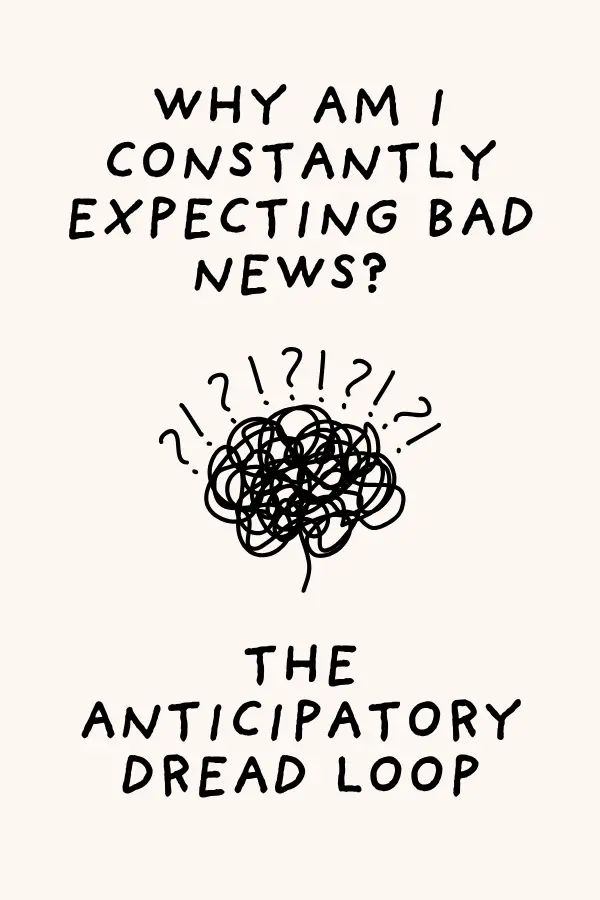
Constantly expecting bad news is not a personality flaw or an overreaction. It is often the result of a nervous system that has learned, sometimes through real past experience, to brace for impact at all times. This guide explores why this happens, what that pattern actually is, and practical ways to begin easing out of it.
Quiet Quitting: Why You Feel Emotionally Burned Out at Work
What Is the Anticipatory Dread Loop?
The anticipatory dread loop describes a cycle where fear of a bad outcome creates constant tension, which then reinforces the belief that something bad must be coming, since the body already feels like it is bracing for danger. It becomes self-perpetuating. The dread creates physical stress signals, and those stress signals get misread as further evidence that disaster is near.
This loop often develops after periods of real instability, trauma, grief, or chronic stress, where bad news genuinely did arrive unexpectedly and repeatedly. Over time, the nervous system generalizes that pattern, applying it to situations that have nothing to do with the original source of harm.
Why Do I Always Expect the Worst to Happen?
If you find yourself asking why do I always expect the worst to happen, the answer usually traces back to your nervous system trying to protect you, even when the protection is no longer necessary. A few common roots:
- Past experiences of being blindsided. If bad news has arrived suddenly and repeatedly before, your brain adapts by trying to predict it in advance, as a form of control.
- Growing up in an unpredictable environment. Chaotic or unstable childhoods often teach a person to stay hyper-alert to any sign of coming trouble.
- Anxiety disorders. Generalized anxiety in particular is closely linked to constantly expecting bad news as a baseline mental state.
- A history of loss. After significant grief, many people develop a heightened sensitivity to the possibility of losing something else.
Constantly expecting bad news, in this light, is less about pessimism and more about a nervous system trying, imperfectly, to keep you safe.
Waiting for the Other Shoe to Drop Anxiety

The phrase waiting for the other shoe to drop anxiety captures this experience well. Good moments start to feel dangerous rather than enjoyable, because deep down there is a belief that peace is temporary and something bad is due. This can show up as:
- Difficulty fully enjoying good news or happy moments
- A persistent sense of unease even when nothing is objectively wrong
- Checking your phone, email, or accounts repeatedly out of a need for reassurance
- Feeling unable to relax fully, even during vacations or downtime
Waiting for the other shoe to drop anxiety is exhausting precisely because it never fully turns off, even in genuinely safe moments.
Reparenting Your Inner Child: A Step-by-Step Healing Guide
Hypervigilance and Anticipatory Anxiety
Hypervigilance and anticipatory anxiety often travel together. It is the nervous system’s state of constant scanning for threat, while anticipatory anxiety is the mental loop of imagining what could go wrong before it happens. Together, they can make even ordinary days feel like a low hum of danger, since the body is primed to detect problems before they have actually occurred.
This combination is common among people with a trauma history, but it can also develop after prolonged periods of stress without a single defining traumatic event, which is part of why so many people find themselves constantly expecting bad news without being able to point to one clear cause.
Want more support for anxious thought patterns like this one? Explore more mental wellness resources here.
Catastrophizing Thoughts Coping Strategies
Catastrophizing thoughts coping strategies can help interrupt the spiral before it fully takes hold. A few to try:
- Name the thought as catastrophizing, out loud if possible. Simply labeling the pattern, “this is my anxiety catastrophizing,” can create a small but meaningful distance from it.
- Ask what evidence actually supports the fear. Separate what you know for certain from what your anxiety is predicting.
- Ground yourself in the present moment. Notice five things you can see, or take slow, deliberate breaths, to signal safety to your nervous system.
- Write down the worst-case, most likely, and best-case outcomes. This can help loosen the grip of the worst-case scenario as the only possibility.
- Limit reassurance-seeking behaviors. Constantly checking for bad news can feel protective, but it usually reinforces the loop rather than calming it.
How to Stop Expecting Bad News
Learning how to stop expecting bad news is rarely instant, but these steps can help shift the pattern over time.
- Track your predictions against reality. Keep a simple log of feared outcomes and what actually happened. Over time, this can build evidence against the anxious pattern.
- Build in regular nervous system regulation. Practices like deep breathing, movement, or time outdoors help lower baseline tension, which reduces how easily the dread loop gets triggered.
- Work with a therapist if the pattern feels persistent. Especially when tied to past trauma, professional support can help address the root cause rather than just the surface symptoms.
- Practice tolerating uncertainty in small doses. Sitting with unanswered questions, rather than needing immediate resolution, builds tolerance over time.
How to stop expecting bad news is ultimately less about forcing positivity and more about teaching your nervous system that it is allowed to rest.
6 Warning Signs of Mental Exhaustion (You Should Never Ignore)
You Are Allowed to Feel Safe in the Present
Constantly expecting bad news is a survival strategy that made sense at some point, even if it no longer serves you the way it used to. With patience and the right tools, it is possible to teach your nervous system that not every quiet moment is a warning sign, and that constantly expecting bad news does not have to be your default setting.
If this guide resonated with you, here is where to go next:
- Try tracking one anxious prediction this week against what actually happens
- Practice one grounding technique the next time dread creeps in during a calm moment
- Share this with someone who might recognize themselves in this pattern of anticipatory dread
Why Does Safety Feel Unsafe? What Your Nervous System Is Doing
Signs of Anxiety Disorder in Adults You Shouldn’t Ignore
Hyper-Independence as a Trauma Response: Why It Happens
7 Stress Management Techniques for Busy Women
Frequently Asked Questions
Why am I always expecting something bad to happen?
Always expecting something bad to happen usually reflects a nervous system that has adapted to real or perceived unpredictability in the past, whether from trauma, chronic stress, or an anxious pattern that developed over time. This state, often described as constantly expecting bad news, is your body’s attempt at protection, even when the current situation does not require it.
What is it called when you always expect the worst?
Always expecting the worst is often referred to as catastrophizing, or more specifically, anticipatory anxiety when it involves ongoing dread about the future. In cases tied to past trauma or chronic instability, it is sometimes described as a repeating dread cycle, since the fear and the physical tension feed each other continuously.
Why am I always expecting the worst?
Constantly expecting the worst often develops as a protective response to past experiences where being caught off guard led to real harm or pain. Over time, this hypervigilance generalizes beyond the original source of danger, applying itself to everyday situations even when there is no immediate threat present.
How to deal with hypochondria?
While hypochondria specifically involves persistent health-related fears, many of the same strategies used for anticipatory anxiety can help, including grounding techniques, tracking anxious predictions against outcomes, and limiting reassurance-seeking behaviors like repeated symptom checking. If health anxiety is significantly affecting daily life, working with a therapist who specializes in anxiety disorders can offer more targeted support.








Leave a Reply