You keep telling yourself it is just stress. The bad sleep, the tight stomach before school or work, the mood swings, the overthinking at 2 a.m. Maybe it is stress. Or maybe it is anxiety that has been quietly taking over.
Knowing the signs of anxiety disorder in adults is not about drama or labels.
It is about noticing when worry starts messing with your daily life and making everything feel harder than it should.
And you are not alone — it affects millions of adults, and a lot of people do not realize it for years.
This article breaks down the physical, emotional, and behavioral signs to watch for, how they are different from normal nerves, and what to do if it sounds a little too familiar.
What Separates Normal Worry From an Anxiety Disorder?
Everyone gets nervous. A first date, a big presentation, a late rent payment — these things are supposed to make your stomach tighten a little. That’s your nervous system doing its job, and it usually clears out on its own once the moment passes.
An anxiety disorder is different in three specific ways:
- The fear is out of proportion. The dread shows up anyway, and it’s just as intense as if the danger were real. Your body reacts to a mildly annoying text message the same way it would react to an actual emergency.
- You can’t turn it off. Normal worry fades once the event passes. Anxiety-disorder worry sticks around, jumping from one subject to the next before you’ve even resolved the first one.
- It gets in the way of your life. When avoidance becomes your main coping strategy, that’s worth a closer look. Small accommodations pile up quietly until one day you realize how much smaller your world has gotten.
There’s also a timing difference worth naming. Situational stress has a clear beginning and end — the presentation happens, then it’s over, and the tension drains out with it.
An anxiety disorder doesn’t wait for a trigger. It can show up on an ordinary Tuesday with nothing wrong at all, which is often the detail that convinces people something more than “a stressful week” is going on.
The Cleveland Clinic frames it plainly: anxiety becomes a disorder when it interferes with your ability to function, when your reactions are consistently out of proportion, and when you can’t control your response no matter how hard you try.
None of that requires a dramatic moment. It’s usually the accumulation of small, repeated instances — not one bad day, but the pattern underneath a string of them.
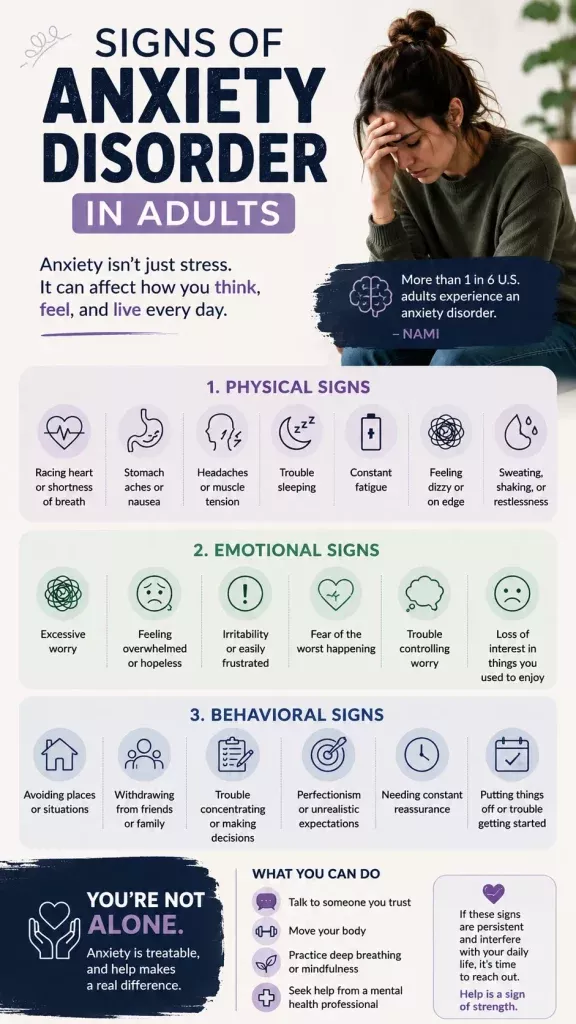
What Are the Physical Signs of Anxiety Disorder in Adults?
Anxiety doesn’t just live in your head. For a lot of people, the body notices first, sometimes for years before anyone connects the dots.
Watch for:
- A racing or pounding heart, even at rest
- Muscle tension, especially in the jaw, shoulders, or neck
- Chronic headaches or unexplained aches
- Trouble sleeping, or waking up exhausted no matter how long you slept
- Stomach issues — nausea, cramping, a churning gut before anything stressful happens
- Sweating, trembling, or hot flashes with no clear trigger
- Shortness of breath or a tight chest
MedlinePlus notes that these physical symptoms are often what actually send people to a doctor’s office. Chest pain gets checked as a heart problem.
Stomach trouble gets treated as a GI issue. The anxiety underneath goes undiagnosed because nobody asked the right question, and the person cycles through tests that keep coming back clear.
If you’ve had the “everything looks normal” conversation with a doctor more than once, it might be worth asking specifically about anxiety.
What Are the Emotional and Cognitive Signs?
This is the part people usually recognize first, even if they don’t call it anxiety.
- Difficulty concentrating. One study of adults with generalized anxiety disorder found that close to 90% struggled to concentrate — anxiety essentially hijacks the working memory you’d normally use to focus.
- A constant sense of dread, even when nothing specific is wrong.
- Irritability that feels disproportionate to whatever set it off.
- Racing thoughts that jump from worry to worry without landing anywhere.
- Catastrophizing — assuming the worst-case outcome is also the likely one.
- Restlessness, a feeling of being keyed up or unable to sit still with your own thoughts.
If any of this sounds like the loop you get stuck in most nights, overthinking and worry aren’t the same thing — worry usually has a specific object, while anxious overthinking can spiral without one, and telling them apart is often the first step toward interrupting the pattern.
How Does Anxiety Show Up in Behavior?
Anxiety reshapes what you do, often in ways that look like personality quirks rather than symptoms.
- Avoidance. Skipping social events, putting off phone calls, taking a longer route to avoid a specific place or person.
- Procrastination. Anxiety about doing a task poorly can be so uncomfortable that not starting feels safer.
- Reassurance-seeking. Repeatedly asking others “are we okay?” or “did I do something wrong?”
- Perfectionism. Overworking a task because “good enough” feels dangerous.
- Withdrawal. Pulling back from relationships to reduce the number of things that could go wrong.
None of these are character flaws. They’re coping strategies your brain built because they worked, at least temporarily. The problem is they tend to shrink your life over time rather than protect it.
What’s the Difference Between Anxiety Types?
Not all anxiety disorders look the same, and knowing which pattern fits can make treatment conversations more useful.
|
Type |
Core Feature |
Common Signs |
|
Generalized Anxiety Disorder (GAD) |
Chronic, hard-to-control worry about everyday things |
Fatigue, muscle tension, trouble concentrating, worry that jumps topics |
|
Panic Disorder |
Sudden, intense episodes of fear |
Racing heart, chest pain, dizziness, a sense of impending doom |
|
Social Anxiety Disorder |
Intense fear of judgment in social settings |
Avoiding gatherings, blushing, rehearsing conversations in advance |
|
Specific Phobia |
Irrational fear tied to one object or situation |
Panic around flying, heights, needles, or similar triggers |
NAMI notes that people often experience more than one of these at the same time, which is part of why anxiety can be so exhausting to live with — the patterns overlap and reinforce each other.
When Should You See a Doctor About Anxiety?
There’s no single symptom that means “now.” It’s more about pattern and duration. Consider reaching out to a professional if:
- Symptoms have lasted more than a few weeks and aren’t easing up
- Anxiety is interfering with work, relationships, or sleep
- You’re avoiding places or situations you used to handle fine
- Physical symptoms have already been checked out medically and nothing else explains them
- You’ve started relying on alcohol or other substances to get through the day
The UC Davis Health team puts it simply: anxiety that’s severe or that interferes with your life is a signal to seek treatment, not something to push through on willpower alone. Anxiety disorders are also among the most treatable mental health conditions, so early conversations tend to pay off.
Building Habits That Support Your Nervous System
Treatment matters most for anxiety disorders, but daily habits can lower the baseline.
A steady self-care routine — enough sleep, regular movement, less caffeine — won’t cure a clinical anxiety disorder, but it does reduce how much your nervous system has to fight through on top of everything else.
If you’ve noticed burnout symptoms bleeding into anxiety, that overlap is common; chronic stress and anxiety tend to feed each other.
FAQ: Signs of Anxiety Disorder in Adults
What are the first signs of an anxiety disorder in adults?
Usually it starts small: tight muscles, bad sleep, and worry that just will not shut up. A lot of people notice the body stuff first, like a racing heart or an upset stomach, before they realize anxiety is the real troublemaker.
Can anxiety disorder develop suddenly in adulthood?
Yes, it can look sudden. Sometimes it has been there for years, then a big life hit — like a breakup, job stress, or health scare — flips the switch.
Is constant fatigue a sign of anxiety?
It can be. Anxiety keeps your body in “uh-oh” mode, and that is exhausting. But tired all the time can also mean other things, so it is not the whole story.
What’s the difference between stress and an anxiety disorder?
Stress usually has a clear cause and calms down when the problem does. Anxiety disorders are sneakier — the worry sticks around, even when there is no obvious reason.
Do men and women show anxiety differently?
Yes, sometimes. Women are diagnosed more often, but men may show it as anger, irritability, or snapping instead of saying, “I am anxious.”
Takeaway
Anxiety disorders are common, treatable, and easy to miss when the symptoms show up as headaches, irritability, or a habit of saying no to plans.
If several of these signs sound familiar and they’ve stuck around for weeks rather than days, that’s worth a conversation with a doctor or therapist — not because something is wrong with you, but because you don’t have to keep managing this alone.

- How to Cope With Grief and Loss: A Compassionate Guide – 10/08/2026
- Love Bombing: Signs, Stages, and What to Do – 03/08/2026
- Signs of Anxiety Disorder in Adults You Shouldn’t Ignore – 29/07/2026







Leave a Reply