Grief doesn’t wait for a convenient time. It shows up in the grocery store, in the middle of a meeting, at 3 a.m. when the house is quiet and your mind won’t stop replaying the last conversation you had with them.
If you’re here because you’re trying to figure out how to cope with grief and loss, you’re probably exhausted, and you probably feel like nobody warned you it would be this hard.
They didn’t warn you because grief is nearly impossible to explain until you’re in it. It’s not a single feeling. It’s shock, anger, guilt, relief, numbness, and sadness, sometimes all in the same hour.
A 2026 survey from Grow Therapy found that two out of three grieving Americans, 67%, have never sought professional support for it.
Most people just try to push through on their own, often without knowing what “normal” grief even looks like.
This guide walks through what grief actually is, what tends to help, and when it’s worth reaching out for more support. There’s no five-step formula that fixes it.
There’s only what gets you through today, and then tomorrow.
What Is Grief, and Why Does It Hurt So Much?
Grief is your mind and body’s response to losing something that mattered. Most people think of it as tied to death, and that’s often the most intense form of it.
But grief also shows up after a divorce, a job loss, a friendship ending, a diagnosis, a move, or a miscarriage. If it meant something to you, losing it is allowed to hurt.
The pain is physical as well as emotional. Grief can leave you exhausted, foggy, and forgetful. You might lose your appetite or eat everything in the fridge at midnight.
You might sleep twelve hours and still wake up tired. None of that means you’re doing it wrong. Your nervous system is processing a loss, and that takes real energy.
What Are the Stages of Grief, and Do You Have to Go Through Them in Order?
You’ve probably heard of the five stages: denial, anger, bargaining, depression, and acceptance.
Psychiatrist Elisabeth Kübler-Ross introduced them back in 1969, and they’ve become the shorthand most people reach for when they talk about grief.
Here’s what almost never gets mentioned: the stages aren’t a staircase. You don’t walk up one, finish it, and move to the next. Grief loops.
You might feel acceptance on a Tuesday and land right back in anger by Thursday, over the same loss, for no obvious reason. That’s not a setback. That’s just how it works.
If you’re grieving the end of a relationship rather than a death, the same stages apply, just with different scenery.
We’ve written before about getting through the early, rawest part of losing someone you loved, and a lot of the emotional terrain overlaps with bereavement grief more than people expect.
How Do You Cope With Grief and Loss Day to Day?
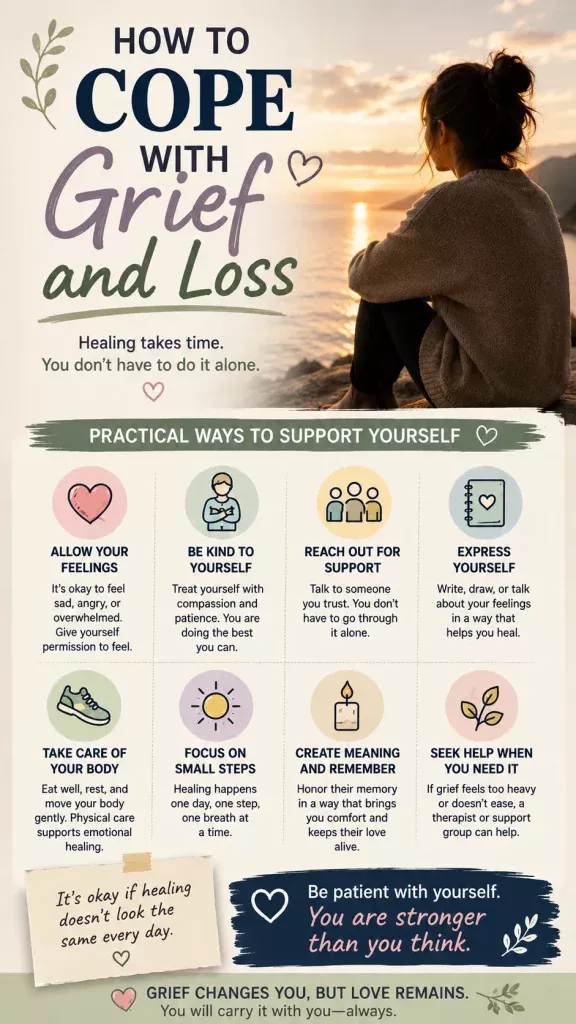
There’s no single right way to grieve, but a few things consistently help people get through it without getting stuck.
- Let yourself feel it instead of scheduling around it. Grief postponed doesn’t disappear. It tends to resurface later, often at a worse time. Cry when you need to cry.
- Say the loss out loud. Talk to a friend, a therapist, or even just your journal. Naming what happened, and what it took from you, makes it a little more real and a little more bearable.
- Keep your body moving, even a little. A short walk won’t fix grief, but it does something for the fog. Movement helps process stress hormones that grief floods your system with.
- Let guilt be part of the process, then release it. Guilt over things left unsaid, or relief that comes with certain losses, is common and doesn’t make you a bad person.
- Lower the bar for what counts as a good day. Showering and eating a real meal is a win some days. Let it be enough.
- Protect your routine where you can. Grief already strips away a sense of control. Keeping small anchors, like a regular bedtime or a Sunday phone call with a friend, gives your days some shape.
If guilt is a big part of what you’re carrying, this piece on forgiving yourself digs into that specific weight, which grief tends to pile on top of everything else.
What Physical Symptoms Come With Grief?
Grief doesn’t stay in your head. Research on bereavement shows roughly 68% of grieving adults report physical symptoms, with fatigue and appetite changes among the most common. You might also notice:
- Tightness in your chest or throat
- Headaches or muscle tension
- Trouble concentrating or “grief brain,” where simple tasks suddenly feel hard
- Disrupted sleep, either too much or too little
- A weaker immune system, since chronic stress wears down your body’s defenses
If grief symptoms are tipping into constant worry, racing thoughts, or a sense of dread that won’t lift, it’s worth reading up on the signs of an anxiety disorder, since grief and anxiety often show up together and get mistaken for one another.
How Do You Support Someone Else Who’s Grieving?
If you’re reading this to help someone else, the most useful thing you can do is usually the simplest: show up and don’t try to fix it.
Skip the phrases that minimize the loss, like “everything happens for a reason” or “at least they’re not suffering anymore.” They’re well-meant, but they tend to land as dismissive.
Instead, sit with them. Ask what they need instead of guessing. Bring food instead of asking if they want food. Follow up weeks later, after everyone else’s texts have stopped, because that’s often when grief hits hardest and support has quietly dried up.
A few grief and healing quotes can also be worth sending, not as a solution, but as a small reminder that someone’s thinking of them.
When Does Grief Become Something You Need Extra Help With?
Most grief eases with time, even when it doesn’t feel that way in the moment. But for some people, it settles in and doesn’t loosen its grip.
The Cleveland Clinic estimates complicated grief, sometimes called prolonged grief disorder, affects about 7% of adults who experience a major loss. Signs include:
- Intense grief that hasn’t softened at all after six months to a year
- Feeling unable to function at work, at home, or in relationships
- Avoiding anything that reminds you of the loss, or the opposite, surrounding yourself with reminders and struggling to move at all
- A sense that life has lost its purpose since the loss
None of that means something is wrong with you.
It means grief counseling, a support group, or working with a licensed therapist, including through online therapy platforms if in-person isn’t realistic for you, could help more than trying to push through alone.
There’s no shame in getting support for something this heavy.
If you’re in crisis or having thoughts of harming yourself, you can reach the 988 Suicide & Crisis Lifeline by calling or texting 988 in the U.S., available 24/7.
Frequently Asked Questions
How long does grief usually last?
There’s no set timeline. Some people notice the sharpest pain easing within months; others carry it for years in a quieter form. Grief tends to change shape over time rather than disappear on a schedule.
Is it normal to feel relief after a loss?
Yes. Relief is common, especially after a long illness or a difficult relationship, and it doesn’t cancel out love or grief. Both can be true at once.
Can grief cause physical illness?
It can weaken your immune system and worsen existing health conditions, particularly in the months right after a major loss. Rest, hydration, and basic self-care matter more than usual during this stretch.
What’s the difference between grief and depression?
Grief usually comes in waves and stays connected to the loss itself, with moments of relief in between. Depression tends to be more constant and can show up without a clear trigger. If low mood and hopelessness stick around most days for weeks, it’s worth talking to a doctor or therapist.
Should I avoid reminders of the person or thing I lost?
Not necessarily. Some people find comfort in photos, rituals, or revisiting places that mattered. Others need space from them for a while. Follow what actually helps you, not what you think you’re supposed to do.
Coping With Grief and Loss Takes Time, Not a Timeline
There’s no finish line where grief officially ends. What usually happens instead is that the weight becomes something you can carry, rather than something that flattens you every single day.
Be patient with yourself on the days it doesn’t feel that way.
If you’re in the thick of it right now, start small. Talk to one person today. Take one walk. Let yourself feel whatever shows up without judging it. That’s most of what coping with grief and loss actually looks like, one ordinary day at a time.

- How to Cope With Grief and Loss: A Compassionate Guide – 10/08/2026
- Love Bombing: Signs, Stages, and What to Do – 03/08/2026
- Signs of Anxiety Disorder in Adults You Shouldn’t Ignore – 29/07/2026







Leave a Reply