You know that feeling when the alarm goes off and your whole body says, “absolutely not”? When even simple tasks feel like dragging a backpack full of bricks? That is burnout. And no, you are not lazy or broken.
Burnout is everywhere right now. The APA says it has roughly doubled since the pandemic, and Gallup found that nearly half of workers feel daily stress. That is a lot of people quietly running on empty.
And it is not just a mood problem. The World Health Organization says mental health conditions cost the global economy about $1 trillion a year in lost productivity. That is not a small leak. That is a full-on flood.
Usually, people hear “fix burnout” and think therapy, meditation, or taking a long break. Great tools, sure. But they are not always easy to get. They can cost money, take time, and feel intimidating. That is why people are starting to look at AI as a possible helper.
So the real question is this: can AI actually help you recover from burnout, or is it just another shiny gadget with big promises? Let us look at what the science says.
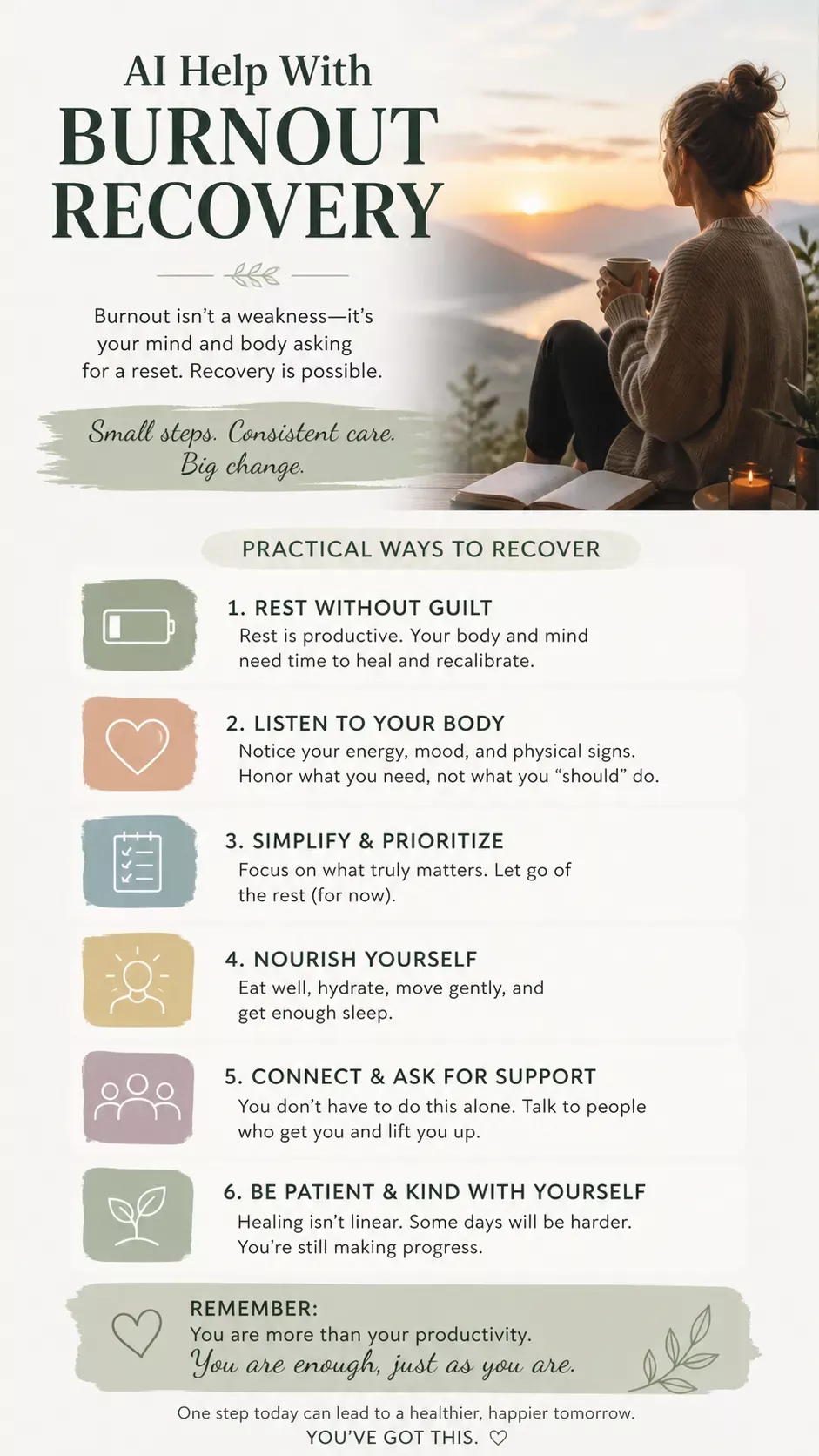
What Is Burnout, Exactly?
Burnout isn’t just “I’m tired, I need a nap.” It’s deeper than that. It’s when your brain and emotions basically say, “yeah… I’m done.”
It usually shows up in three ways:
- You feel completely drained (like your battery’s stuck at 1%)
- You start not caring — about school, work, people, everything
- You feel like nothing you do even matters anymore
Stress feels like too much going on. Burnout feels like you’ve got nothing left to give. Big difference. And fixing it isn’t just about rest — you’ve gotta change how you think, work, and live.
That’s where AI starts getting interesting.
How AI Is Being Used in Burnout Recovery
1. AI Therapy Chatbots
Imagine having someone to talk to at 2 a.m. who actually helps you sort your thoughts. Apps like Woebot and Wysa use therapy techniques (like CBT) to help you manage stress, reframe negative thoughts, and track your mood.
And this isn’t just hype — recent studies show these tools can actually help reduce anxiety, depression, and burnout symptoms, especially when you’re feeling overwhelmed.
2. Passive Burnout Detection via AI
This one’s kinda cool… and a little creepy. Some AI tools can spot burnout before you even notice it.
They look at patterns — how fast you type, how you talk, your sleep, even your heart rate. If things start going downhill, the system can flag it early. Some setups have even reduced sick days by a lot and can predict mental health dips with surprisingly high accuracy.
Basically, it’s like your phone quietly going, “hey… you’re not okay.”
3. AI-Powered Wellness Apps
There are also apps that help you fix the basics — sleep, stress, focus, movement. These tools learn your habits and adjust recommendations just for you.
So instead of generic advice like “just relax,” you get something that actually fits your life.
4. AI for Workload Automation
Sometimes burnout isn’t deep — it’s just… too much annoying stuff. Emails, reports, scheduling — all the little things that pile up.
AI can take a chunk of that off your plate. And when you remove the constant mental clutter, your brain finally gets space to breathe.
Less busywork = less burnout. Simple as that.Humanize 361 words
What the Research Says: Promising, But Nuanced
The research says AI can actually help with burnout — but it is not magic, and it is definitely not a robot therapist in a hoodie.
On the positive side:
- Studies on AI chatbots show real drops in loneliness, depression, and stress
- They can help people build coping skills, anytime and anywhere, without the usual money or travel barriers
- Newer research also suggests AI chatbots can improve anxiety, depression, and burnout in measurable ways
On the limitations side:
The research is still early, and the results are not always consistent
- AI cannot truly feel empathy the way a human can, and that matters a lot in mental health
- Some apps can just echo your thoughts instead of helping you challenge them
- AI should never replace a licensed therapist for serious burnout or deeper mental health issues
The big takeaway? AI can be a useful sidekick, but not the main hero.
Who Benefits Most From AI Burnout Tools?
AI tools seem to help most when burnout is still in the early stages — kind of like catching a small fire before it becomes a full blaze.
Best for:
- People with mild to moderate burnout
- People who cannot easily access therapy because of cost, distance, or time
- Teachers, healthcare workers, executives, and other high-stress workers
- People noticing early warning signs before things get worse
- Teams or companies that want support at scale
Less helpful for:
- People in crisis
- People with serious mental health conditions
- People who need deep, human, trauma-informed therapy
How to Use AI Tools for Burnout Recovery: A Practical Guide
Alright, imagine burnout like your phone battery stuck at 5% all day. AI is not the charger — but it can help you stop draining so fast.
Step 1: Assess Your Level of Burnout
First, figure out how serious it is. Tools like the Maslach Burnout Inventory can help. And if things feel really dark — like scary thoughts or total shutdown — skip the apps and talk to a real human professional. That is priority number one.
Step 2: Choose Evidence-Based Apps
Not all apps are created equal. Some are helpful, some are just vibes and pretty colors. Look for ones based on real science like CBT or mindfulness, built with actual mental health experts, and with clear privacy rules. If it feels shady, it probably is.
Step 3: Use AI as a Daily Complement, Not a Crisis Tool
Think of AI like brushing your teeth — small daily habits that keep things from getting worse. Mood tracking, breathing exercises, journaling… great. But if your world is on fire, this is not the fire department.
Step 4: Combine AI With offline Recovery Strategies
This is the part people try to skip. You cannot “app” your way out of a life that is exhausting you. If AI helps you notice you are overworked or not sleeping, you still have to act on it — set boundaries, rest, talk to people, change things in real life.
Step 5: Advocate For AI Wellness Tools at Work
If you are in a position to speak up, do it. Companies are starting to use AI tools to support employees, and it actually helps. Less stress, better focus, happier people. Turns out humans work better when they are not completely fried.
The Ethical Dimension: AI and Mental Health Privacy
Here is the slightly creepy part: these apps can know a lot about you. Your mood, your stress, even your late-night thoughts.
So before you trust one, ask:
Who can see my data?
- Can I delete it?
- Are they protecting it properly?
- Are they selling it? (Big red flag)
Basically, do not hand over your brain diary to just anyone.
Conclusion: AI Is a Powerful Tool — But You Still Have to Do the Work
So yeah — AI can help with burnout. That is real. It can support you, guide you, and be there anytime you need it.
But it cannot hug you. It cannot fix a toxic job. It cannot magically turn your life into something you actually enjoy.
Think of it like a really smart sidekick. Helpful? Absolutely. The hero of the story? That is still you.
The best recovery plan is not “AI or everything else.” It is AI plus real life changes. And honestly? That combo is way more powerful than most people realize.

- How to Cope With Grief and Loss: A Compassionate Guide – 10/08/2026
- Love Bombing: Signs, Stages, and What to Do – 03/08/2026
- Signs of Anxiety Disorder in Adults You Shouldn’t Ignore – 29/07/2026







Leave a Reply