You call out the lie, and somehow five minutes later you are the one saying sorry. That twist has a name: DARVO, and it is one of the sneakiest manipulation tricks out there.
If an argument leaves you confused, guilty, and wondering how you ended up as the bad guy, this is probably why.
DARVO is slippery because it can sound like a normal fight, until the blame suddenly lands on you.
Here is what DARVO is, the 3 stages it follows, 7 signs it is happening, and how to deal with it.
The 3 Stages of DARVO
DARVO isn’t random venting, it follows a predictable sequence almost every time. Here’s how it plays out.
1. Deny
The person refuses to acknowledge the behavior happened, or shrinks it down to nothing.
“That never happened.” “You’re remembering it wrong.” “It wasn’t that big a deal.” The goal isn’t to convince you, it’s to make you start doubting your own memory before the conversation even continues.
2. Attack
The focus shifts from the behavior to your character or credibility. “You’re so dramatic.” “Why do you always do this?” “You’re being crazy right now.”
Suddenly you’re not discussing what happened, you’re defending who you are.
This overlaps a lot with covert passive-aggressive narcissist traits the attack is rarely a shout, more often a quiet dig disguised as a joke or a “concern.”
3. Reverse Victim and Offender
This is the finishing move. The person recasts themselves as the one who’s been wronged: “I can’t believe you’d accuse me of that after everything I’ve done for you.”
The original concern is gone. You’re now the one managing their hurt feelings.
Notice what’s missing from all three stages: any actual response to your original concern. That’s the point.
DARVO isn’t a rebuttal. It’s a redirection.
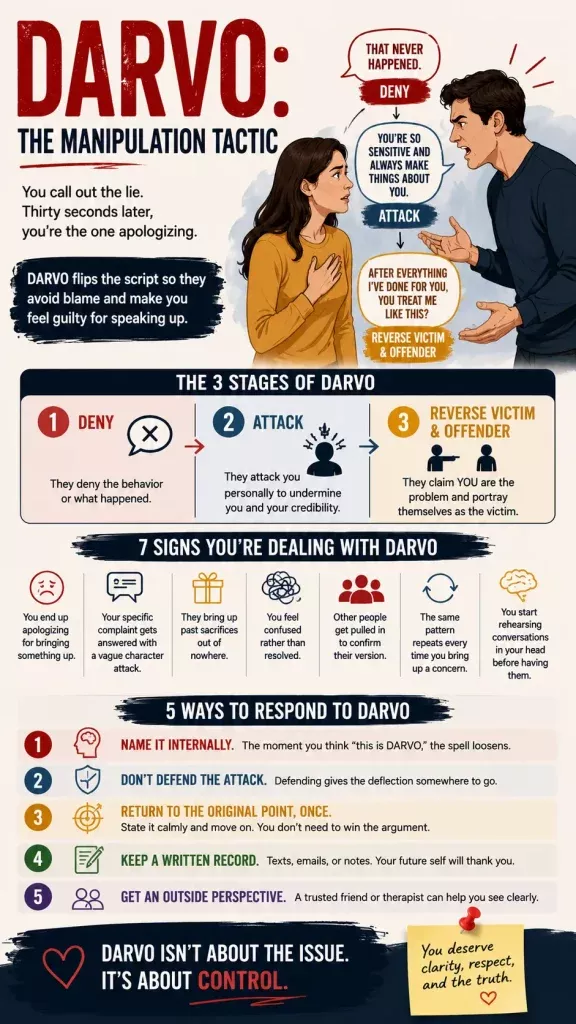
7 Signs You’re Dealing With DARVO
1. You end up apologizing for bringing something up
You started the conversation because something genuinely bothered you. A few minutes later, you’re the one saying, “I’m sorry.”
It feels like walking into a room with your phone and somehow leaving without it. You know something changed, but you cannot figure out when.
2. Your specific complaint gets answered with a vague character attack
You say, “You were an hour late and didn’t text.” Instead of answering that, they fire back with, “You’re so controlling.”
See the trick? The conversation jumps from what happened to what’s supposedly wrong with you. It is like changing the rules halfway through a game because you’re losing.
3. They bring up past sacrifices out of nowhere
Suddenly it’s, “After everything I’ve done for you.” That has nothing to do with the problem you raised. The goal is to make you feel guilty, so you stop asking perfectly reasonable questions.
4. You feel confused rather than resolved after the conversation
Even tough arguments usually leave you understanding what happened. DARVO does the opposite.
You walk away replaying every word in your head, wondering if you imagined the whole thing. That confusion is often part of the tactic.
5. Other people get pulled in to confirm their version
Before you even tell your side, they have already talked to friends, family, or coworkers. They paint themselves as the victim, making it harder for others to see what really happened.
It can feel like showing up to a movie after everyone has already heard spoilers.
6. The same pattern repeats every time you bring up a concern
Everyone has bad days. But if every conversation follows the same script deny, attack, then make themselves the victim that is not bad luck. It is a pattern.
If it has been happening for years, the emotional damage can quietly build over time.
7. You start rehearsing conversations in your head before having them
Do you practise what you’re going to say because you already expect the conversation to get twisted? That is a huge red flag.
Your instincts are trying to protect you because they have seen this pattern before.
Is DARVO the Same as Gaslighting?
They’re related but not identical. Gaslighting is about rewriting your perception of reality over time making you doubt your memory, your judgment, even your sanity.
DARVO is a specific, reactive sequence that plays out in the moment someone is confronted. Gaslighting can happen without DARVO.
DARVO almost always involves a gaslighting component, since denying and reversing the narrative requires convincing you your read on events is wrong.
Think of gaslighting as the long game and DARVO as one especially effective play within it.
5 Ways to Respond to DARVO Without Getting Pulled In
1. Name it internally, even if you don’t say it out loud
The second you think, “This is DARVO,” everything starts making more sense.
It is like spotting the magician’s trick. Once you know what’s happening, it is much harder to fall for it.
2. Don’t defend against the character attack
If they suddenly say, “You’re too sensitive,” don’t take the bait.
You do not have to prove who you are. The more you argue about their insult, the further the conversation drifts away from the real issue.
3. Return to the original point, once, calmly
Try something simple like, “I hear you’re upset. I still want to talk about the text messages.”
Then leave it there. You are not trying to win an argument. You are trying to stay focused on the actual problem.
4. Keep a written record if this is a pattern, not a one-off
Save text messages, emails, or even jot down what happened in a private notebook. Memory gets fuzzy, especially after stressful conversations.
Looking back at your notes later can remind you that you are not imagining things.
5. Get an outside perspective from someone you trust
Talk to a friend, family member, or therapist who was not involved. Sometimes another person can spot what you cannot because they are not caught up in the emotions.
DARVO works best when it makes you feel alone. A fresh perspective helps break that cycle.
None of these steps can stop someone from trying DARVO again.
What they can do is help you recognise the pattern, trust yourself, and stop getting pulled into the same trap every time.
FAQ
Is DARVO always a sign of narcissism?
No. It can show up in workplaces, politics, and everyday fights too. But in narcissistic or abusive relationships, it is especially common because nobody wants to admit they messed up.
Can someone do DARVO without meaning to?
Yes. Sometimes it is a reflex, like snapping before thinking. Other times it is totally deliberate. Either way, the effect is the same: you end up feeling blamed for speaking up.
Why do I feel so confused after an argument like this?
Because that confusion is part of the trap. DARVO is built to make you doubt your own memory, like your brain just got put in a blender.
Does DARVO happen outside relationships?
All the time. You will see it in workplaces, public scandals, and anywhere someone wants to dodge accountability.
What should I do if this is part of abuse?
Talk to a therapist or a domestic violence advocate. You do not need the whole story sorted out before you ask for help.
The Bottom Line
DARVO works because it’s fast, disorienting, and aimed at exactly the qualities that make you a thoughtful, fair-minded person.
Recognizing the pattern deny, attack, reverse won’t stop someone else from using it. But it will stop you from spending the next three days wondering if you’re the one who did something wrong.
If this pattern sounds familiar and you’re trying to make sense of a bigger relationship, our guides on spotting narcissistic behavior early and recognizing manipulation in a relationship are good next stops.
And if you’re already past the confusion and working on rebuilding, healing from narcissistic abuse covers what that process can actually look like.
For a deeper dive, our list of the best books on healing from narcissistic abuse is a solid place to start, and sometimes it just helps to know you’re not the only one these narcissistic abuse quotes put words to a lot of what this experience feels like.

- How to Cope With Grief and Loss: A Compassionate Guide – 10/08/2026
- Love Bombing: Signs, Stages, and What to Do – 03/08/2026
- Signs of Anxiety Disorder in Adults You Shouldn’t Ignore – 29/07/2026







Leave a Reply