Your partner has a great weekend with you, then suddenly acts like feelings are a trap. You try to talk, and they dodge it, shut down, or give you the classic non-answer. If that hits home, you might be dealing with avoidant attachment — basically, someone who wants closeness but panics when it gets too real.
And they are not rare. A lot of adults sit somewhere on the avoidant spectrum, which is why this shows up so often in dating. This guide breaks down what avoidant attachment looks like, where it comes from, and what to do if you are the one pulling away or the one getting left hanging.
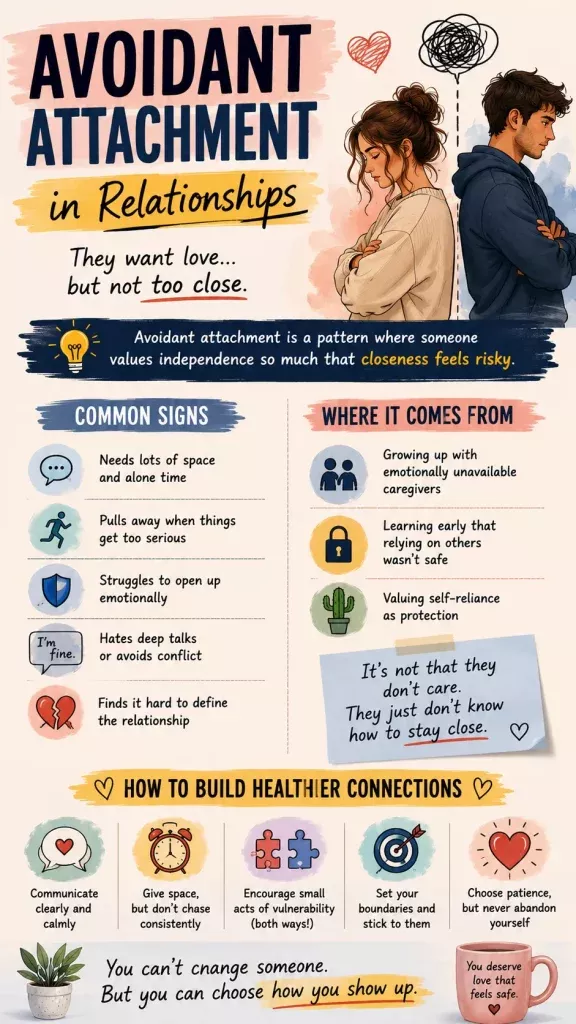
What Is an Avoidant Attachment Style?
Avoidant attachment is one of the three insecure attachment styles, alongside anxious and disorganized (also called fearful-avoidant). At its core, it’s a pattern of prioritizing independence and self-reliance over emotional closeness, not because intimacy doesn’t matter, but because it feels risky.
People with this style tend to believe, on some level, that they can’t fully count on others. So they stop asking. They handle a health scare, a work crisis, or a rough day largely on their own, and they’re often genuinely puzzled when a partner wants to talk feelings through instead of just moving on.
This isn’t the same as simply being independent or introverted. Plenty of people value alone time and still build deeply connected relationships. Avoidant attachment specifically involves discomfort with vulnerability itself: sharing needs, admitting fear, asking for comfort.
Where Does Avoidant Attachment Come From?
Attachment styles form early, usually before a child can even talk about what’s happening to them. A caregiver who was distant, dismissive of emotions, or uncomfortable with affection teaches a child a simple lesson: don’t expect comfort, and don’t bother asking for it. Over years, that lesson can harden into something close to emotional autopilot, where feelings get pushed so far down they barely register.
Over time, the child adapts. Rather than protesting an unmet need, they stop expressing it at all. Psychologists call this a deactivating strategy, a way of suppressing the urge to seek closeness before it can be turned down again.
It works, in the sense that it protects a kid from repeated disappointment. It’s a lot less useful three decades later, in a relationship with someone who wants to feel let in.
A few other things can push someone toward avoidant patterns:
- Growing up with a caregiver who punished or mocked emotional expression
- Being praised mainly for independence and self-sufficiency, rarely for vulnerability
- Experiencing a painful betrayal or loss in a past relationship that reinforced “don’t rely on people”
- Cultural or family messaging that equates needing others with weakness
How Avoidant Attachment Shows Up in Relationships
Here’s where things get concrete. A partner with an avoidant attachment style will often:
- Hesitate to define the relationship or commit to future plans, even after months together
- Pull back right when things start to feel serious, sometimes fixating on a partner’s minor flaws as a reason to create distance
- Handle stress, illness, or bad news alone instead of turning to their partner
- Struggle to say “I love you” or express affection verbally, even if it’s clearly there in their actions
- Shut down or go quiet during conflict rather than working through it together
- Keep some part of their life, thoughts, or schedule separate, even from a long-term partner
- Feel smothered by a partner’s requests for more time, texting, or reassurance
None of this is a verdict on how much they care. Underneath the distance, most avoidant partners still want connection. They’re just running an old script that treats vulnerability as a liability.
If you’ve dealt with a partner who seems allergic to being pinned down, it’s worth reading up on what makes someone clingy, which is often the mirror-image pattern: low self-esteem and fear of abandonment driving someone to chase reassurance instead of avoid it.
Avoidant and anxious styles frequently end up paired together, each amplifying the other’s worst tendencies.
Dismissive-Avoidant vs. Fearful-Avoidant: Same Family, Different Experience
Not all avoidant attachment looks alike. The two main subtypes handle closeness in noticeably different ways.
|
Dismissive-Avoidant
|
Fearful-Avoidant
|
|
| Core belief | I don’t need closeness to be okay |
I want closeness, but it isn’t safe
|
| Behavior pattern | Steady, predictable distance |
Push-pull, hot-and-cold cycles
|
| Typical origin | Emotionally neglectful or unavailable caregiving |
Frightening or chaotic caregiving
|
| Reaction to conflict | Withdraws, minimizes the issue |
May withdraw, then swing into anger or intense reconnection
|
| Underlying need | Genuinely values autonomy over intimacy |
Craves intimacy but expects it to lead to pain
|
Dismissive-avoidant partners tend to be the more predictable of the two. They keep a fairly consistent distance and rarely swing back toward intense closeness on their own. Fearful-avoidant partners, sometimes grouped under disorganized attachment, oscillate: warm and available one week, cold and unreachable the next. That inconsistency is often more confusing for a partner to navigate than steady avoidance, precisely because it seems to promise something that then disappears.
What Happens When an Avoidantly Attached Person Falls in Love
It’s a common misconception that avoidant partners simply don’t fall in love, or fall in love less. They do. What changes is how comfortable they are once real intimacy starts building.
Early on, an avoidant partner might seem engaged and even affectionate, especially while the relationship still has some emotional distance built in. Once the relationship deepens, the same closeness that felt good can start to feel like pressure. That’s usually when withdrawal kicks in, sometimes right after a period of unusual closeness, like a great vacation or a vulnerable conversation.
This can look like sabotage from the outside. It rarely is. It’s closer to an alarm system going off, one that was calibrated in childhood to treat “too close” as “too dangerous,” even when the adult relationship in front of them is nothing like the one that built the alarm in the first place.
Can Someone With Avoidant Attachment Change?
Yes — but not by magic, and not just by waiting it out. These patterns can change, because they were learned in the first place.
A few things actually help:
Naming the Pattern
Just noticing, “I pull away when things get close,” can be a huge deal. That one sentence can stop you from acting like your fear is the truth.
Practicing Small Acts of Vulnerability
You do not have to spill your whole soul at once. Start small. Ask for help. Share one worry. It is basically emotional training wheels.
Working With a Therapist
Therapy can help a lot, especially when both people are trying to understand the pattern instead of just blaming each other.
Choosing a Securely Attached Partner
A calm, steady partner can make closeness feel safer over time. It is like learning that not every hug is a trap.
If you are dating someone avoidant, the trick is not to chase them like a lost Wi-Fi signal. Give them space, but do not disappear yourself. Stay kind, stay clear, and protect your own boundaries too.
Frequently Asked Questions
Is avoidant attachment the same as being an introvert?
No. Introversion is about where you recharge energy, typically alone versus around people. Avoidant attachment is specifically about discomfort with emotional closeness and vulnerability, regardless of how social or solitary someone is.
Can two avoidantly attached people date each other successfully?
It happens, and it can feel comfortable at first since neither partner is pushing the other for more closeness. Over time, though, both people may end up under-communicating needs, which can leave the relationship feeling stable but emotionally shallow.
Does avoidant attachment mean someone will cheat?
Not inherently, but some research links avoidant attachment to a higher likelihood of secrecy or infidelity, largely because avoidant partners struggle to express dissatisfaction directly and may instead create distance in less honest ways.
How is fearful-avoidant different from dismissive-avoidant?
Dismissive-avoidant partners genuinely minimize their need for closeness and stay steady in their distance. Fearful-avoidant partners want closeness but fear it will lead to rejection or harm, which produces a more unpredictable, push-pull dynamic.
Should I stay with a partner who has avoidant attachment?
That depends on whether they’re willing to acknowledge the pattern and work on it, even gradually. A partner who recognizes their avoidance and stays engaged in the relationship despite discomfort is a very different situation than one who refuses to acknowledge the impact it’s having on you.
Moving Forward
Avoidant attachment isn’t a character flaw, and it isn’t a life sentence either. It’s a protective habit that made sense once and now gets in the way of the closeness a person actually wants. Whether you’re recognizing these patterns in yourself or in someone you love, the first real step is simply naming what’s happening instead of taking the distance personally. From there, change is genuinely possible, one small act of honesty at a time.

- How to Cope With Grief and Loss: A Compassionate Guide – 10/08/2026
- Love Bombing: Signs, Stages, and What to Do – 03/08/2026
- Signs of Anxiety Disorder in Adults You Shouldn’t Ignore – 29/07/2026







Leave a Reply