You text him, no reply for three hours, and suddenly you’re rereading every conversation from the last two weeks looking for the moment things went wrong. If that spiral feels familiar, you might be dealing with an anxious attachment style, one of the most common (and most exhausting) patterns in relationships.
Anxious attachment style signs show up as a near-constant need for reassurance, a habit of reading too much into silence, and a nervous system that treats distance like danger. None of this makes you needy or broken. It’s a learned pattern, and learned patterns can be unlearned.
This article breaks down what anxious attachment actually looks like, where it comes from, and what actually helps.
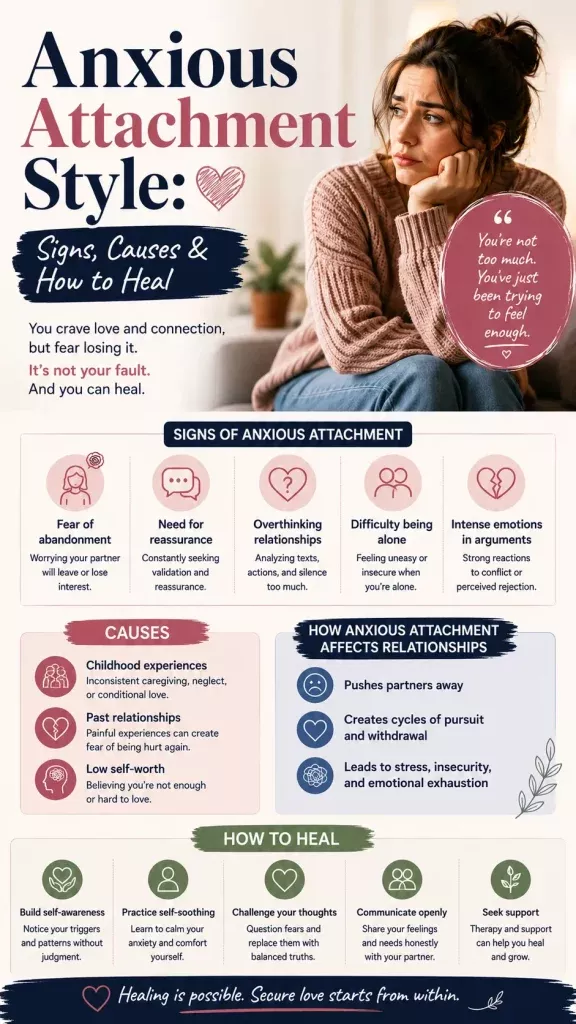
What Is an Anxious Attachment Style?
Attachment theory groups people into four broad styles: secure, anxious, avoidant, and disorganized (a mix of anxious and avoidant traits). Anxious attachment, sometimes called anxious-preoccupied attachment, describes people who deeply want closeness but doubt it will stick around.
Psychologists trace this back to attachment research from the 1970s, which found that roughly one in five adults fall into the anxious-preoccupied category. That’s a huge number of people quietly convinced their partner is one bad mood away from leaving.
The push and pull is what makes it so draining. You want intimacy more than almost anything, but every gap in communication reads like proof it’s slipping away.
What Are the Signs of an Anxious Attachment Style?
Some signs are things you feel internally. Others are things a partner, friend, or family member would actually notice from the outside. Here’s how it tends to show up:
Constant Need For Reassurance.
You keep asking, “Are we okay?” even when nothing seems wrong. It’s like your brain keeps asking for proof that the relationship is still safe. Wanting reassurance sometimes is normal. Needing it all the time can point to anxious attachment.
Overanalyzing Texts and Tone.
A simple “ok” turns into a full crime investigation. You reread messages looking for hidden meanings when the other person was probably just busy. Anxious attachment loves to imagine the worst.
Fear of Abandonment That Outpaces The Evidence.
Even in a healthy relationship, you worry they’ll leave. It’s like waiting for a storm on a sunny day. The fear feels real, even if there’s no sign it’s actually coming.
Difficulty Being Alone.
A little time apart can feel much longer than it really is. Your brain treats distance like danger, even when everything is completely fine.
People Pleasing at Your Own Expense.
You hide your real thoughts and keep saying “I’m fine” because you’re scared of pushing people away. But healthy relationships should make space for the real you.
Jealousy or Possessiveness.
This usually isn’t about not trusting your partner. It’s about not trusting that the relationship will last. Your fear starts telling stories that aren’t true.
Taking Things Personally.
If someone needs space or has a bad day, you instantly wonder, “Did I do something wrong?” Anxious attachment can make you carry problems that were never yours to begin with.
If several of these sound like your Tuesday, you’re not alone, and you’re definitely not the only one who’s ever Googled “why am I so clingy” at 1 a.m.
What Causes an Anxious Attachment Style?
Most researchers point back to early childhood, specifically to caregiving that was inconsistent rather than absent. A parent who was warm and present sometimes, then distracted, stressed, or unavailable other times, teaches a child’s nervous system an unpredictable lesson: love is real, but you can’t count on it showing up when you need it.
That inconsistency, according to Therapy Group of DC, teaches the nervous system to turn up its “connection alarm.” Better to over-signal for closeness than risk missing a chance at it.
Other contributing factors include:
- Emotional neglect or unpredictable parenting
- A parent with their own anxious attachment style, passed down without either person realizing it
- Exposure to a parent’s mental illness or substance use
- Overprotective or intrusive parenting that blurred boundaries
- Early instability, like frequent moves, divorce, or loss
None of this means anxious attachment is permanent or genetic. It’s a survival strategy your brain built early on, and brains are remarkably capable of building new ones.
How Does Anxious Attachment Show Up in Relationships?
In practice, anxious attachment tends to surface as a specific set of relationship habits: over-texting, needing frequent check-ins, replaying conversations, and reading rejection into things that were never meant that way. Left unaddressed, it can tip into relationship paranoia, where minor, everyday moments start feeling like evidence of a much bigger problem.
There’s also a well-documented pull between anxious and avoidant partners. Anxious attachment craves closeness; avoidant attachment craves space. Pair the two together and you get a cycle where one person chases and the other retreats, which only confirms the anxious partner’s fear that connection is unstable. This dynamic gets especially painful when the avoidant partner also shows narcissistic or manipulative traits, since an anxious partner’s hunger for reassurance can make them easier to keep off balance.
Anxious Attachment vs Other Attachment Styles
| Attachment Style | Core Belief | Common Behavior |
Relationship Pattern
|
| Secure | “I’m worthy of love, and it’s generally reliable.” | Communicates needs directly |
Comfortable with closeness and independence
|
| Anxious (preoccupied) | “I want closeness, but it might disappear.” | Seeks frequent reassurance |
Clings when stressed, fears abandonment
|
| Avoidant (dismissive) | “I can only rely on myself.” | Pulls away during conflict or intimacy |
Values independence over closeness
|
| Disorganized (fearful-avoidant) | “I want closeness, but it also feels dangerous.” | Alternates between pursuing and withdrawing |
Unpredictable, often shaped by past trauma
|
How Can You Heal an Anxious Attachment Style?
Healing doesn’t mean you stop wanting closeness. It means the wanting stops running the show.
1. Name The Pattern in The Moment.
The next time panic shows up, stop and tell yourself, “This is my anxious attachment talking. I’m not in danger.” That one sentence can keep you from sending a message you’ll regret five minutes later.
2. Practice Self Soothing.
Before you text, call, or ask, “Are you mad at me?” try calming yourself first. Go for a walk, listen to music, or take a few deep breaths. You’d be surprised how many problems disappear once your brain settles down.
3. Get Curious About Your Triggers.
What sets you off? Maybe it’s being left on read, canceled plans, or someone sounding a little different than usual. Once you know your triggers, they stop sneaking up on you.
4. Build a Life That Isn’t Entirely Centered on Your RRelationship.
Your partner should be an important part of your life, not your whole life. Spend time with friends, pick up hobbies, and chase your own goals. The fuller your life feels, the less pressure you put on one person to make you feel okay.
5. Consider Therapy.
Therapy isn’t about being broken. It’s like having a coach for your emotions. A good therapist can help you understand where these fears came from and teach you healthier ways to handle them.
6. Choose Partners Who Can Hold Steady.
You deserve someone who communicates clearly, keeps their promises, and doesn’t play mind games. They can’t heal your anxious attachment for you, but a calm, consistent relationship can make healing feel a whole lot easier.
Frequently Asked Questions
Is anxious attachment the same as being needy?
No. Being called “needy” is a label. Anxious attachment is a learned pattern where your brain works overtime to keep relationships safe.
Can someone with anxious attachment become securely attached?
Absolutely. With self awareness, healthy relationships, and sometimes therapy, you can build a more secure way of connecting with people.
Do anxious and avoidant attachment styles always end up together?
Not always, but it happens a lot. One person chases while the other pulls away, creating a frustrating cycle that’s hard to break.
What’s the difference between anxious ambivalent and anxious preoccupied attachment?
They’re basically the same pattern. One name is used for childhood, while the other describes how it shows up in adult relationships.
Can anxious attachment cause anxiety disorders?
Not by itself. They’re different things, but they can happen together. If you’re dealing with both, talking to a therapist can really help.
The Bottom Line
An anxious attachment style isn’t a character flaw. It’s a pattern your nervous system built to keep you safe, and like any pattern, it can shift with awareness and practice. If the signs above sound familiar, start small: notice one trigger this week, and try responding to it differently than you have before.

- How to Cope With Grief and Loss: A Compassionate Guide – 10/08/2026
- Love Bombing: Signs, Stages, and What to Do – 03/08/2026
- Signs of Anxiety Disorder in Adults You Shouldn’t Ignore – 29/07/2026







Leave a Reply