The grocery store is playing holiday music already. Your group chat is busy with who is bringing the pie. And somewhere in the middle of all that cheer, there is an empty chair that you cannot stop seeing. That is what grief during the holidays can feel like.
If you are carrying that weight this year, please know you are not doing anything wrong by feeling heavy while everyone else seems to feel light. Whether Thanksgiving is just ahead or already behind you, there is still time to think about what you need this season, not just what everyone expects. Below you will find 10 gentle, expert-informed ways to cope, honor the person you miss and protect your heart, whether your loss happened this spring or many years ago.

Why Grief Feels Heavier During the Holidays
The holidays are built around family, tradition and togetherness, which is exactly why a loss can feel so loud right now. Mayo Clinic Health System calls the holidays one of the hardest stretches of the year after a death, since everyday sights, sounds and smells can stir up memories and make the grief feel new again. The smell of her stuffing. His favorite football game on in the background. The ornament they always hung first.
Grief is not only emotional, either. In a Mayo Clinic Q&A on holiday grief, Jessie Wolf, a licensed independent clinical social worker with Mayo Clinic Health System, explains that grief can also show up in your body. You may tire more easily, have trouble eating or sleeping, struggle to concentrate, feel more prone to headaches and other illnesses, or have a shorter fuse than usual. As Wolf puts it: “You’re not imagining these reactions. They’re real.”
Wolf also offers a reminder worth writing on a sticky note: “There is no right or wrong way to grieve. Go at your own pace.” If you want to understand your feelings more deeply, our guides to the stages of grief and how to cope with grief and loss are a kind place to start.
10 Gentle Ways to Cope With Grief During the Holidays
You do not need to try all of these. Pick the two or three that feel doable, and let the rest wait.
1. Plan Ahead for the Hard Moments
Grief rarely hits on schedule, but some moments are easy to predict: walking into the house, saying grace, the first toast, the drive home. Mayo Clinic Health System suggests picturing the toughest parts of the day ahead of time and building a plan you feel at ease with. That might mean arriving late and leaving early, driving yourself so you can step out when you need to, or deciding in advance who you will text if it gets to be too much.
2. Tell Your People What You Need
The people who love you cannot read your mind, and many of them are scared of saying the wrong thing. Mayo’s experts recommend letting family and friends know early what you need, so no one is surprised that this year looks different. A simple text works: “I want to come, but I might need a quiet break after dinner. Please don’t take it personally.” If you need help finding the words, our holiday boundaries scripts can be adapted for grief.
3. Give Yourself Permission to Change Traditions
Maybe you cannot face hosting at the same table this year. Maybe you want to eat out, volunteer or skip the parade entirely. Mayo Clinic Health System says you can adjust or skip some traditions this year, and that a change made now does not have to become permanent. In other words, this year can simply be this year. You can decide again next November.

4. Say Yes When People Offer Help
When someone says “Let me know if you need anything,” try taking them up on it. Mayo suggests accepting offers of help with shopping, decorating, cooking and other holiday tasks. Hand off the side dish your loved one always made, or let a friend pick up the groceries. Accepting help is not weakness. It frees up a little energy for the things only you can do.
5. Make Room for Their Memory
Many people fear that talking about the person they lost will “ruin” the day. Often the opposite is true. Mayo Clinic Health System encourages sharing memories with family and friends, noting that memories can bring laughter and tears, and that both are OK and can be healing. Lisa De Sieno, director of Bereavement Services in Eau Claire, Wisconsin, writes: “Your loved one is missed but not forgotten.” You could ask everyone to share a favorite story, or pair this with our gratitude letter guide and write a few lines to the person you miss.
6. Light a Candle or Create a Tribute
Rituals give grief somewhere to go. One idea from Mayo Clinic Health System is to light a special holiday candle and set it somewhere meaningful as a sign that love lives on. You could also create a tribute that honors their passions, such as a scrapbook, a birdhouse, a tree you plant together or keepsake ornaments made with family and friends.

7. Let Tears and Laughter Share the Table
You might laugh hard at an old family joke and then cry in the bathroom ten minutes later. That is not a contradiction. It is love, showing up in two different outfits. Wolf also notes that tears may come easily in unexpected places, or may not come at all. Whatever your reaction, Wolf’s advice is to honor your process. Try not to judge yourself.
Wolf’s closing words in the Mayo Clinic Q&A are some of the most comforting lines we have read about loss:
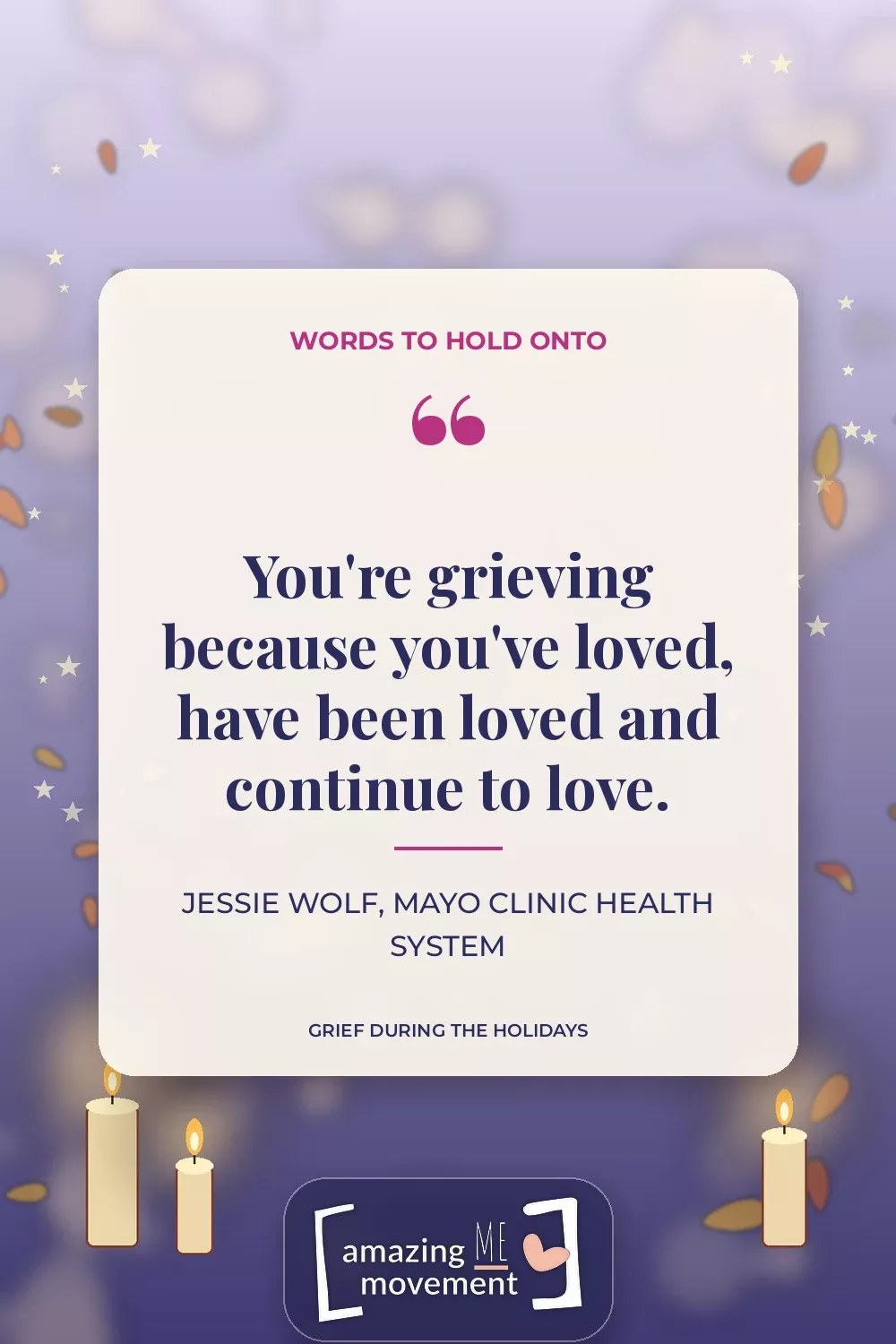
“You’re grieving because you’ve loved, have been loved and continue to love.”
Jessie Wolf, Mayo Clinic Health System
8. Protect Your Body and Your Energy
Holiday weeks are full of late nights, rich food and long drives, all while grief is already draining your battery. Mayo’s advice is simple: treat yourself kindly, eat nourishing food when you can and protect your sleep. Schedule real downtime between events, take short walks in the crisp fall air, and say no to the extras that do not matter this year. If you are also juggling work deadlines, our tips on avoiding holiday burnout and letting go of guilt about self-care may help.
9. Remember That Kids Grieve Too
If there are children in your family, Mayo Clinic Health System points out that they are often the forgotten mourners. Unlike adults, children can move in and out of grief quickly, which is normal. One minute they are sad about Grandpa, the next they are asking for more pie. Give them chances to talk about how they feel, include them in sharing memories, and offer plenty of reassurance. Letting them help make an ornament or decorate the memory candle can be a sweet way to involve them.
10. Find People Who Understand
Sometimes the most healing thing is sitting with people who just get it. According to Mayo’s experts, grief counseling or a grief support group can help, since realizing you are not the only one struggling can change a lot. Ask your doctor, a local hospice or your faith community about grief support groups near you. Connecting with others can also help you see that what you are going through is normal.

What to Say to Someone Who Is Grieving This Thanksgiving
Maybe you are reading this for a friend, a sister or a coworker. You do not need perfect words. A few gentle options:
- “I’ve been thinking about you and missing [name] too. How are you really doing?”
- “No pressure to come, but there is a seat for you if you want it, and you can leave whenever you like.”
- “I’d love to hear your favorite story about [name] sometime.”
- “Can I drop off dinner one night next week?”
Saying their loved one’s name out loud is often a gift. Most grieving people are not afraid you will remind them of the loss. They are afraid everyone else will forget.
When to Reach Out for Extra Support
The American Psychiatric Association explains that for most people, grief eases with time and does not get in the way of daily life, even if feelings sometimes rise again at certain points, like the holidays. For a smaller group, intense grief lasts longer and makes daily life very hard. This is called prolonged grief disorder, and the APA cites estimates that it affects about 4% to 15% of bereaved adults. Evidence-based treatments are available, including approaches that use elements of cognitive behavioral therapy.
If it has been a year or more since your loss and you still feel stuck, numb, intensely lonely or unable to engage with friends, work or the future, please talk with your doctor or a licensed therapist. For children and adolescents, the APA names a threshold of at least six months. You do not have to wait that long, though. If grief feels like too much at any point, reaching out is a strong and loving choice, and our guide on how to ask for help when you feel hopeless can walk you through it. If you are in crisis or having thoughts of suicide, help is available right now. In the US, call or text 988 to reach the 988 Suicide & Crisis Lifeline, which is free, confidential and available 24/7. In Canada, call or text 9-8-8 to reach 9-8-8: Suicide Crisis Helpline, also free and available 24 hours a day. If you are in immediate danger, call 911.
Frequently Asked Questions
Is it normal for grief to come back during the holidays?
Yes. Whether your loss was recent or happened years ago, Mayo Clinic notes that feelings of grief can be heightened during the holiday season. A wave of sadness in November does not mean you have gone backward. As we often say, healing is not linear.
Should I skip Thanksgiving if I’m grieving?
You are allowed to. You are also allowed to go for one hour, or to celebrate in a smaller, quieter way. There is no single right choice, only the one that feels kindest to you this year.
How can I honor a loved one at Thanksgiving dinner?
Light a candle, cook their signature dish, set out a favorite photo, or invite everyone to share one memory before the meal. Keep it simple and let it feel natural.
How Will You Honor Your Heart This Season?
Grief and gratitude can sit at the same table. You can miss someone terribly and still notice the warm pie, the friend who texted, the quiet moment when the candle flickers. Be patient with yourself this month, and take it one day, one meal, one breath at a time.
Which of these ideas feels right for you this year? Is there a tradition you’ll keep, change or create in your loved one’s honor? Tell us in the comments. What you share could be the very thing another grieving reader needs today.
This article is for general information and support and is not a substitute for professional medical or mental health advice. If you are struggling, please reach out to a licensed professional.








Leave a Reply