In a world full of motivational reels and “get rich in 5 seconds” hacks, Immanuel Kant brings a different kind of power: calm, serious, and surprisingly useful. He was not a self-help guru, but his ideas are packed with lessons about discipline, responsibility, and becoming the kind of person you respect in the mirror.
Think of it like this: Kant is the strict coach who does not yell for attention, but somehow makes you better anyway.
Whether you are trying to figure out your future, stay focused in school, or just stop drifting through life, Kant has a lot to say. His words can help you think more clearly, act with purpose, and grow into someone stronger and wiser.
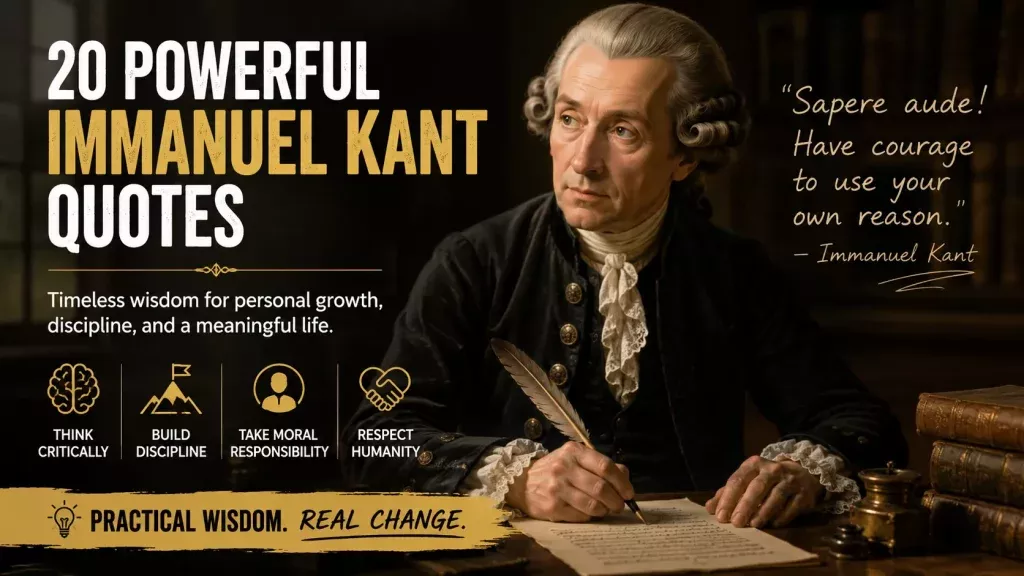
Below are 20 of Immanuel Kant’s most powerful personal growth quotes — each with a simple breakdown of how it can actually help your life today.
The Power of Reason and Self-Knowledge
1. “Two things fill the mind with ever new and increasing admiration and awe: the starry heavens above me and the moral law within me.”
— Critique of Practical Reason, 1788

Kant believed that personal greatness begins with awe — awe at the universe and awe at the moral capacity within every human being. Growth starts when you recognize that you carry an inner compass greater than any external rulebook.
Takeaway: Reconnect with wonder. Take time each week to reflect on what genuinely moves you — it is a direct path to purpose.
2. “Seek not the favor of the multitude; it is a very unequal exchange to sacrifice the esteem of all wise men for the applause of all fools.”
Social media culture rewards performance over substance. Kant warns against chasing mass approval at the expense of genuine respect. Personal growth demands that you prioritize the opinion of a few wise mentors over the applause of the crowd.
Takeaway: Curate your feedback circle intentionally. Who are the three wisest people whose opinion shapes your decisions?
3. “All our knowledge begins with the senses, proceeds then to the understanding, and ends with reason.”
Learning is not a single act — it is a three-stage process. Kant maps out a cognitive journey from raw experience, to organized understanding, to principled reasoning. This is a powerful framework for skill development and lifelong learning.
Takeaway: When mastering any new domain, don’t rush to conclusions. Let your senses gather data, your understanding organize it, and your reason form principles.
- Read Also: 20 Aristotle Quotes on Love That Still Ring True Today
- Read Also: 20 Johnny Depp Quotes About Love That Will Make You See Romance Differently
Discipline, Action, and Moral Courage
4. “We are not rich by what we possess but by what we can do without.”

Modern consumerism equates accumulation with success. Kant flips this — true richness is the freedom that comes from inner sufficiency. Minimalism, financial discipline, and emotional non-attachment are all forms of personal power.
Takeaway: Audit what you need versus what you want. Reducing dependency on external things dramatically increases your freedom.
5. “Act only according to that maxim whereby you can at the same time will that it should become a universal law.”
— Groundwork of the Metaphysics of Morals, 1785
This is Kant’s Categorical Imperative — arguably the most famous ethical principle in Western philosophy. It is a litmus test for every decision: Would the world be a better place if everyone acted as I am about to act? It holds you personally accountable without needing external enforcement.
Takeaway: Before your next major decision, ask yourself: “What if everyone did this?” The answer will clarify your action instantly.
6. “In law, a man is guilty when he violates the rights of others. In ethics, he is guilty if he only thinks of doing so.”
Kant understood that personal growth is an inside job. You cannot fully separate your actions from your intentions. Moral development begins in thought, long before behavior.
Takeaway: Practice mental accountability. Journal your intentions, not just your actions. Growth requires honesty about what you almost did.
7. “Dare to know! Have the courage to use your own understanding.”
— What Is Enlightenment?, 1784
This is Kant’s rallying cry for intellectual independence — his Sapere aude principle. He urged people to stop outsourcing their thinking to authority figures and to trust their own reasoning capacity. It remains one of the most radical calls to personal empowerment ever written.
Takeaway: Identify one area of your life where you have been following someone else’s framework without question. Challenge it this week.
Purpose, Meaning, and Human Dignity
8. “Morality is not properly the doctrine of how we may make ourselves happy, but how we may make ourselves worthy of happiness.”

There is a difference between chasing happiness and earning it through moral and purposeful action. Kant distinguishes between hedonic pleasure and eudaimonic well-being — a distinction deeply supported by modern positive psychology research.
Takeaway: Reframe your daily goals. Instead of “How do I feel happier today?” ask “What did I do today that I am genuinely proud of?”
9. “Always recognize that human individuals are ends in themselves, and do not use them as means to your ends.”
In a hyper-networked world where relationships are sometimes reduced to transactional value, Kant’s insistence on human dignity is a profound corrective. Authentic personal growth requires building genuine relationships, not just useful ones.
Takeaway: Review your key relationships. Are you engaging with people as whole human beings, or primarily as means to your own goals?
10. “It is not God’s will merely that we should be happy, but that we should make ourselves happy.”
Kant places agency squarely in your own hands. Happiness is not passively received — it is actively constructed. This is one of the most empowering ideas in all of philosophy.
Takeaway: Take full ownership of your emotional state today. List three concrete actions you can take this week to build the life you want.
Growth Through Challenge and Resilience
11. “From such crooked wood as that which man is made of, nothing straight can be fashioned.”

Kant acknowledged human imperfection not as an excuse, but as an honest starting point. Personal growth is not about becoming perfect — it is about bending imperfect material toward something better.
Takeaway: Stop waiting to be “ready.” Begin from exactly where you are, with exactly who you are.
12. “We can judge the heart of a man by his treatment of animals.”
Empathy is a trainable skill, not a fixed trait. Kant understood that how we treat the most vulnerable around us reveals the true state of our inner development.
Takeaway: Practice small daily acts of kindness — not to be seen, but to build character from the inside out.
13. “A good will is not good because of what it accomplishes, but because of what it wills.”
Outcomes are not always in your control — but intentions are. Kant’s ethics of goodwill is a powerful antidote to perfectionism. Your growth is measured by the quality of your choices, not the mercy of your circumstances.
Takeaway: When results disappoint, evaluate your intentions first. If they were sound, recommit to the process, not just the outcome.
14. “The busier we are, the more acutely we feel that we live, the more conscious we are of life.”
Purposeful action creates a felt sense of aliveness. Kant valued engaged, committed living over passive observation — a mindset remarkably aligned with modern concepts of flow developed by psychologist Mihaly Csikszentmihalyi (1990).
Takeaway: Fill your schedule with meaningful work, not just urgent tasks. Busyness in service of purpose is deeply fulfilling.
Legacy, Contribution, and Lasting Change
15. “The possession of power inevitably spoils the free use of reason.”

True personal growth requires constant vigilance against ego. The more authority or success you accumulate, the harder it becomes to think clearly and remain open to correction.
Takeaway: Actively seek out perspectives that challenge your current position — especially when you are most confident.
16. “Science is organized knowledge. Wisdom is organized life.”
Information overload is the defining challenge of our era. Kant distinguishes between the accumulation of facts (knowledge) and the integration of experience into a lived philosophy (wisdom). Personal growth is the journey from one to the other.
Takeaway: Don’t just consume more content. Regularly reflect on how what you have learned has changed how you live.
17. “Immaturity is the incapacity to use one’s intelligence without the guidance of another.”
This ties directly to Kant’s concept of enlightenment. Dependence on external validation, constant advice-seeking, and fear of independent thought are all signs of psychological immaturity — and the path out is deliberate practice of autonomous reasoning.
Takeaway: Make one significant decision this month entirely on your own reasoning, without outsourcing it to someone else’s opinion.
18. “Handle a book as a bee does a flower: extract its sweetness but do not damage it.”
Learning should be active, not passive. Kant’s metaphor encourages readers to engage deeply, critically, and selectively — rather than consuming blindly. This is the hallmark of a growth mindset (Dweck, 2006).
Takeaway: Read fewer books, but engage with them more deeply. Annotate, reflect, and apply.
19. “The greatest human quest is to know what one must do in order to become a human being.”
This quote captures the entire project of personal development in a single sentence. Growth is not about accumulation — it is about becoming. It is the ongoing, imperfect, courageous project of figuring out what a fully realized human life looks like for you.
Takeaway: Write your own definition of a “fully realized version of yourself.” Then identify the one habit that most stands between you and that person.
20. “Live your life as though your every act were to become a universal law.”
A paraphrase of his Categorical Imperative, this is perhaps Kant’s most actionable quote for daily life. It is a built-in accountability system — a question you can ask before every email sent, every word spoken, every choice made.
Takeaway: Post this quote somewhere visible. Let it be your daily decision filter.
- Read Also: 20 Uplifting Fall Quotes To Ignite Change and Growth
- Read Also: 20 Life Quotes About Change To Help You Start Your Next Chapter
Conclusion: Kant’s Timeless Blueprint for the Modern Growth Journey
Immanuel Kant was not writing for TikTok. He was writing for the long game, and that is exactly why his ideas still hit hard today. He talks about courage, discipline, self-respect, and doing the right thing even when nobody is clapping for you.
The big message from all 20 quotes is simple: real growth starts inside you. Not with a perfect app, not with some loud influencer, and not with a “5-minute life reset” video. It starts when you think for yourself, stay disciplined, and treat people with genuine respect.
Pick one quote that really stuck with you. Write it down. Keep it somewhere you will see it. Let it challenge you. Because the strongest life is not the one that just happens by accident — it is the one you choose to build.

- How to Cope With Grief and Loss: A Compassionate Guide – 10/08/2026
- Love Bombing: Signs, Stages, and What to Do – 03/08/2026
- Signs of Anxiety Disorder in Adults You Shouldn’t Ignore – 29/07/2026







Leave a Reply