You know that weird moment when your brain throws out a shocking thought for no reason at all — like, “What if I dropped the baby?” or some random disturbing image in the middle of class or a meeting? Yeah. That does not make you a bad person. It makes you a human being with a very dramatic brain.
Those are called intrusive thoughts, and almost everyone gets them. The good news? They usually mean nothing scary about you — they’re just mental noise. Let’s break that down in a way that actually makes sense.
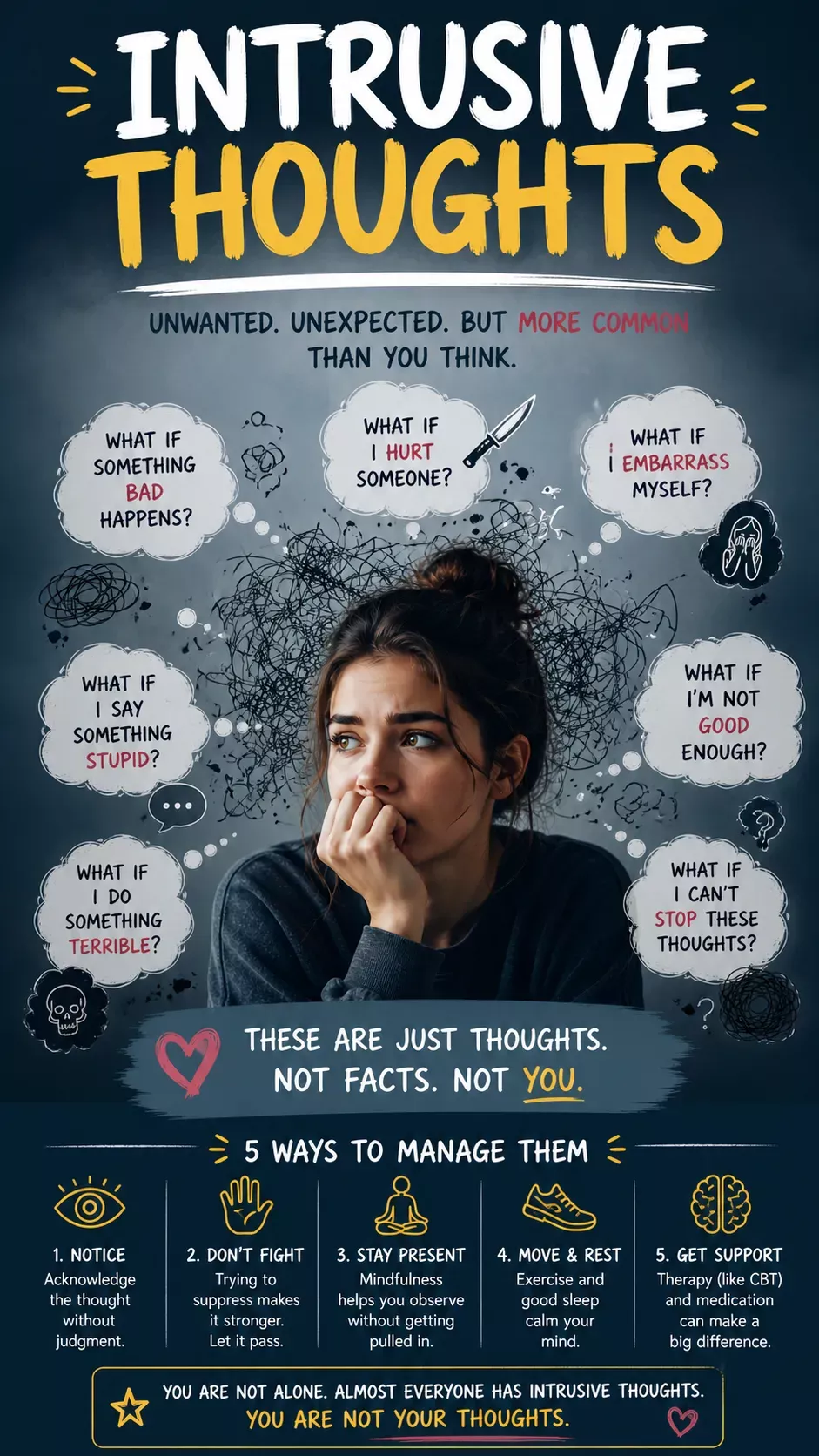
What Are Intrusive Thoughts, Exactly?
Intrusive thoughts are those random, unwanted thoughts or images that crash into your brain like an uninvited pop-up ad. You don’t choose them. Your brain just blurts them out sometimes — usually at the worst possible moment.
What freaks people out is that these thoughts often go completely against who they are. A kind person imagines hurting someone. A loving parent has a scary thought about their child. And then your brain goes, “Wait… why did I think that?!” Cue panic.
But here’s the important part: the fact that the thought bothers you is actually a good sign. It means the thought doesn’t match your real values.
So, Does Everyone Really Experience Intrusive Thoughts?
Yep. Pretty much everyone.
Studies have found that around 94% of people experience intrusive thoughts. That means nearly every person you know — your friends, teachers, parents, even the most calm and “normal” people — has had weird or disturbing thoughts pop into their head.
The difference is that most people eventually brush them off like mental junk mail. The thoughts may feel scary or embarrassing, but they’re a normal part of having a human brain, not proof that something is wrong with you.
What Kinds of Intrusive Thoughts Do People Have?
Intrusive thoughts can be about basically anything. They do not care if you are sweet, smart, funny, shy, or the “good kid” in class. As one psychologist put it, they are often disturbing, but they can show up in a lot of different forms.
Here are the most common ones:
1. Violent or Harm-Related Thoughts
Random thoughts about hurting yourself or someone else — like pushing, hitting, or stabbing — even though you do not want to do any of that. These can feel terrifying because they are the exact opposite of who you are.
2. Sexual Thoughts
Weird, unwanted sexual thoughts about the wrong person or the wrong situation. Super uncomfortable? Yes. Rare? Not even close. People just do not talk about them much.
3. Religious or Blasphemous Thoughts
Sudden disrespectful thoughts about God, religion, or sacred things. These can hit people hard because they feel so shocking and so unlike them.
4. Contamination Fears
Thoughts about germs, dirt, or something being “gross” or unsafe. It can feel like your brain is yelling, “Do not touch that!” even when nothing is actually wrong.
5. Doubt and Safety Concerns
The classic brain loop: “Did I lock the door?” “Did I leave the stove on?” “Am I forgetting something huge?” Your brain loves acting like a paranoid alarm system for no reason.
6. Social Embarrassment Thoughts
Awkward little horror movies in your head about saying something embarrassing, making a fool of yourself, or doing something cringey in public. Basically, your brain becomes a fake drama queen.
Why Does the Brain Generate These Thoughts?
Your brain is basically an overprotective security guard. Sometimes it throws out random worst-case scenarios like, “What if something terrible happened?” even when you would never actually do it.
Think of it like your brain accidentally hitting the panic button for no reason. Mental hiccup. False alarm. Weird pop-up ad. Whatever you call it, the thought is usually not a secret desire — it is just your brain trying way too hard to protect you.
Certain things can make intrusive thoughts louder too:
- Stress — your brain gets jumpy when life feels overwhelming
- Lack of sleep — tired brains are messy brains
- Anxiety — anxious minds love replaying scary “what if” scenarios
- Big life changes — grief, pressure, school stress, family problems, new responsibilities
- Mental health conditions — like OCD, PTSD, depression, or anxiety disorders
The Crucial Difference: Normal Intrusive Thoughts vs. a Mental Health Concern
Here is the important part: having intrusive thoughts is normal. Getting trapped in them is when it may become a mental health issue.
| Normal Intrusive Thoughts |
Potentially Problematic
|
| Fleeting, passing quickly |
Persistent, recurring daily
|
| Cause mild momentary discomfort |
Cause significant anxiety or distress
|
| Don’t interfere with daily life |
Disrupt work, relationships, or functioning
|
| Easily recognized as “just a thought” |
Feel like commands or deep moral truths
|
| Not accompanied by compulsive behaviors |
Followed by rituals, checking, or avoidance
|
People with intrusive thoughts are not more likely to act on them. In fact, the reason the thoughts feel so upsetting is usually because they go completely against the kind of person you really are.
When Intrusive Thoughts Become a Clinical Concern
Most intrusive thoughts are just annoying mental pop-ups. But if they keep happening, feel super intense, and start messing with school, sleep, work, or relationships, they can be a sign of something deeper.
The most common ones are:
Obsessive-Compulsive Disorder (OCD)
OCD is when unwanted thoughts get stuck on repeat, and a person feels driven to do rituals or checking behaviors to calm the anxiety. It is not just “having weird thoughts.” It is a real pattern that takes over a lot of time and energy.
Post-Traumatic Stress Disorder (PTSD)
PTSD can bring back traumatic memories as vivid flashbacks that feel almost real. These thoughts are not random in the same way — they are tied to trauma, and they can hit like a punch to the chest.
Generalized Anxiety Disorder (GAD) and Depression
Anxiety and depression can also make intrusive thoughts show up more often and feel heavier. A therapist can help figure out what is really going on.
New Parents: A Special Note
This part surprises a lot of people: many new parents, especially new moms, have scary thoughts about harm coming to their baby. That does not mean they want to do harm. It usually means their brain is on max alert because they care so much.
The key difference is this: upsetting thoughts that make you horrified are not the same as dangerous intentions. If these thoughts feel overwhelming, postpartum OCD is real, treatable, and nothing to be ashamed of.
5 Evidence-Based Strategies for Managing Intrusive Thoughts
If intrusive thoughts are stressing you out, here are some things that actually help — not fake “just think positive” advice.
1. Label the Thought, Don’t Marry It
When a weird thought shows up, try saying: “Okay… that was random.”
That is it. Do not treat it like a prophecy or a secret message from your soul. Brains produce weird stuff sometimes, like a Spotify playlist on shuffle with no supervision.
2. Stop Fighting the Thought
This sounds backward, but trying to force a thought away usually makes it louder. It is like when someone says, “Do not think about pizza,” and suddenly pizza is all you can think about. Let the thought pass instead of wrestling with it.
3. Practice Mindfulness
Mindfulness teaches you how to notice a thought without spiraling into panic. Think of it like watching cars pass by instead of jumping into traffic with every single one.
4. Sleep and Move Your Body
Lack of sleep turns your brain into an emotional raccoon digging through garbage at 3 a.m. Sleep matters. Exercise helps too because it calms stress and interrupts overthinking loops.
5. Therapy Really Helps
Cognitive Behavioral Therapy (CBT) is one of the best tools for intrusive thoughts. For OCD, a specific type called ERP is especially effective. Sometimes medication can help too, especially if anxiety or depression is involved.
When to Seek Professional Help
It is a good idea to talk to a mental health professional if intrusive thoughts:
- Take over a big part of your day
- Cause intense fear, shame, or panic
- Lead to compulsions or rituals
- Make school, work, friendships, or daily life harder
- Feel impossible to dismiss or control
And if you are having thoughts of suicide or self-harm, reach out to a crisis line or trusted adult immediately. You deserve support, not silence.
The Bottom Line
Yes — almost everyone gets intrusive thoughts. That does not mean you are broken, weird, or secretly dangerous. It just means your brain sometimes throws out nonsense like a glitchy app.
These thoughts do not define your character. They are not hidden desires, and they are not predictions about what you will do. In fact, the people most upset by them are usually the ones who care the most about doing the right thing.
You do not need to “delete” every intrusive thought. That is impossible. The real power move is to stop treating them like truth and start seeing them for what they are: mental noise.

- How to Cope With Grief and Loss: A Compassionate Guide – 10/08/2026
- Love Bombing: Signs, Stages, and What to Do – 03/08/2026
- Signs of Anxiety Disorder in Adults You Shouldn’t Ignore – 29/07/2026







Leave a Reply