Grief isn’t a school test with five boxes to check. You don’t move from denial to acceptance like you’re unlocking levels in a video game. If your emotions feel all over the place, that’s normal.
The five stages of grief helped people understand loss, but they were never meant to be a rulebook. Real grief is messy, personal, and different for everyone.
This guide explains what the stages really mean, where they fall short, and what actually helps when you’re going through loss.
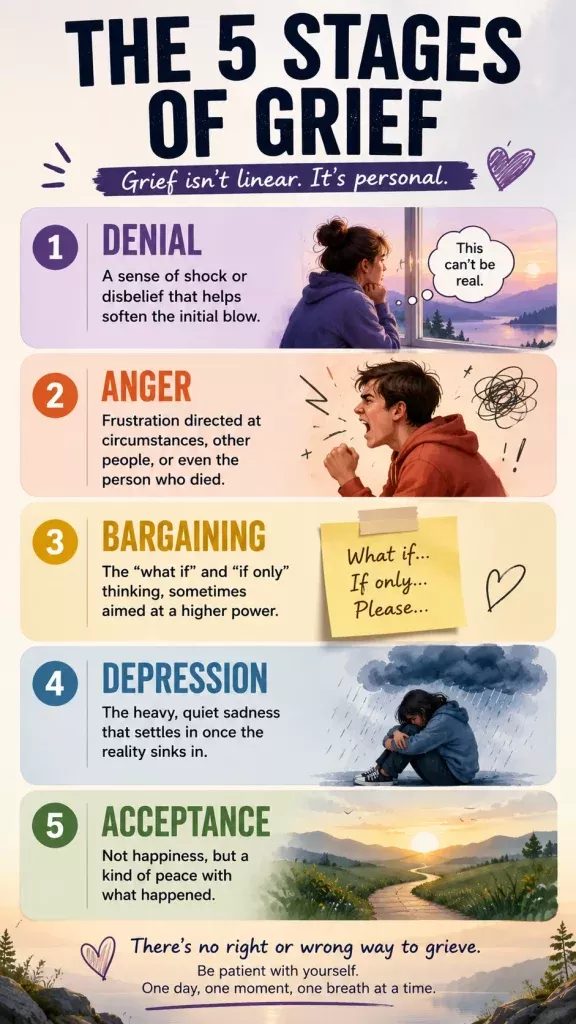
What Are the Five Stages of Grief?
The five stages of grief come from Elisabeth Kübler-Ross’s 1969 book On Death and Dying. Here’s something a lot of people don’t know: she was talking about people facing their own death, not people grieving someone they lost. Over the years, that detail got lost, and the stages started being treated like a rulebook for everyone. They were never meant to be.
The five stages, as usually described:
Denial
That feeling of, “This can’t be real.” Your brain almost hits the pause button because the truth is too overwhelming to take in all at once.
Anger
You might feel angry at life, doctors, family, yourself, or even the person who died. It can feel unfair because, honestly, it is.
Bargaining
This is where your mind keeps replaying the past. “What if I had called?” “If only I’d done something differently.” It’s your brain searching for a way to change something that can’t be changed.
Depression
The shock fades, and the sadness settles in. Everything can feel heavier, quieter, and harder than it used to.
Acceptance
Acceptance doesn’t mean you’re happy about what happened or that you’ve “moved on.” It simply means you’re starting to live with the reality of the loss instead of fighting it every day.
Why the Stages of Grief Aren’t Actually a Straight Line
Here’s the part that would have saved a lot of people a lot of unnecessary guilt: grief was never meant to move in order. You don’t finish denial and graduate to anger.
You might feel acceptance on a Tuesday and get flattened by anger again on Thursday.
Psychologist George Bonanno’s research on bereavement, one of the more influential bodies of work in the field over the past two decades, found that many people are more resilient than the stage model implies — some never experience anything like “depression” as a discrete phase, and plenty move in and out of stages in whatever order their nervous system decides.
A widely cited NIH breakdown of modern grief research puts it bluntly: there’s no wrong way to grieve, and waiting for stages to arrive in sequence can actually get in the way of processing what’s happening.
So if your grief looks like chaos instead of a staircase, that’s not a sign you’re doing it wrong. That might just be what grief actually looks like.
Is There Really a Seventh Stage?
Somewhere along the way, the five stages picked up two more. Grief educator David Kessler, who co-authored later work with Kübler-Ross, is often credited with popularizing an expanded seven-stage version that adds:
- Shock — the initial numbness right after the news, before denial even fully sets in
- Testing — a middle stage where you start experimenting with new routines or ways of coping, before landing on acceptance
Whether you count five stages or seven, the underlying idea is the same: these are common emotional territories people pass through, not a fixed itinerary.
Some people will recognize six of the seven in their own experience. Others will only recognize two or three. Both are normal.
| Model | Stages |
Who popularized it
|
| 5-stage (DABDA) | Denial, Anger, Bargaining, Depression, Acceptance |
Elisabeth Kübler-Ross, 1969
|
| 7-stage | Shock, Denial, Anger, Bargaining, Depression, Testing, Acceptance |
Expanded by later grief educators, including David Kessler
|
How Long Do the Stages of Grief Really Last?
There’s no universal timer. Medical sources generally note that acute grief symptoms often ease within one to two years for most people, but “easing” isn’t the same as disappearing, and plenty of people carry a version of their grief for the rest of their lives — it just changes shape.
A few things that tend to affect the timeline:
- How sudden or expected the loss was
- Whether the relationship was close, complicated, or unresolved
- Existing mental health, support systems, and even sleep and physical health
- Whether the loss is grief over a death, or grief over something else entirely — a breakup, a job, a diagnosis, a friendship that quietly ended
That last point matters more than most grief content admits. The stages of grief show up just as hard after a relationship implodes as they do after a death.
If you’ve ever felt denial, anger, and something like depression after a breakup and wondered if you were being dramatic, you weren’t. Grief doesn’t check whether the loss was “big enough” to count.
What Happens When Grief Gets Stuck?
For most people, grief gradually loosens its grip, even if it never fully leaves. But for some, it doesn’t loosen — it calcifies.
Researchers now recognize this as prolonged grief disorder (sometimes called complicated grief): a pattern where the intensity of early grief doesn’t ease over time and instead keeps interfering with daily functioning well past what’s typical.
Signs it might be worth talking to a professional rather than waiting it out:
- Grief that feels just as intense a year or more later as it did in the first weeks
- Avoiding anything that reminds you of the loss, to an extent that shrinks your life
- Feeling like a part of your identity died along with the loss, with no sense of moving forward
- Persistent thoughts that life isn’t worth living without the person or thing you lost
That last one is worth pausing on. If grief has brought you to thoughts of not wanting to be here, that’s a sign to reach out for support now, not later — a therapist, a doctor, or a crisis line if things feel urgent.
How Do You Cope With the Stages of Grief?
There isn’t a magic trick that makes grief disappear. But there are things that genuinely help you carry it a little better, one day at a time.
Let the stages be messy.
Forget trying to figure out which stage you’re “supposed” to be in. Grief doesn’t follow a schedule. Some days you’ll feel okay, and the next day one small memory can hit you like a truck. That’s normal.
Talk about the loss out loud.
You might tell the same story over and over, and that’s okay. Rebecca Soffer, founder of Modern Loss, says that putting grief into words often makes it easier to carry.
You don’t need someone to fix it. Sometimes you just need someone to listen.
Keep a simple routine.
When life feels upside down, small habits matter. Eat something, get some sleep, take a short walk, or shower. It sounds basic, but those little wins remind your brain that life is still moving forward.
Write it down.
Your journal doesn’t have to sound like a bestselling novel. Write the messy thoughts, the anger, the questions, or even one sentence about your day. Getting it out of your head can be surprisingly freeing.
Give yourself more time than you think you need.
Healing isn’t a race. Whether you’re grieving someone who died or the end of a relationship, don’t pressure yourself to “be over it” by a certain date. Real healing happens at its own pace.
Lean on other people’s words when yours won’t come.
Some days it’s impossible to explain what you’re feeling. That’s when a meaningful quote, poem, or story can say exactly what your heart can’t. Sometimes borrowing someone else’s words is enough to help you make it through the day.
FAQ
Are the stages of grief scientifically proven?
Not exactly. They helped people understand grief, but research shows grief is much more personal and unpredictable than a simple five-step process.
Do you have to go through all five stages?
No. You might skip some, repeat others, or never experience certain stages at all. There’s no “right” way to grieve.
Can you grieve something that isn’t a death?
Yes. A breakup, losing a job, drifting apart from someone, or letting go of a dream can hurt just as deeply.
What’s the difference between grief and depression?
Grief usually comes in waves, with good moments mixed in. Depression is often more constant and affects nearly every part of life.
When should someone get professional help for grief?
If grief keeps you from living your daily life, doesn’t ease over time, or leaves you feeling like life isn’t worth living, reach out to a therapist or grief counselor. You don’t have to carry it alone.
The Bottom Line
The stages of grief were never meant to be a checklist, and treating them like one just adds pressure to an already painful process. Denial, anger, bargaining, depression, acceptance — and for some, shock and testing besides — are common stops, not a required route.
Grief that loops back on itself, skips stages, or lasts longer than you expected isn’t a malfunction. It’s what happens when something mattered.
If you’re in it right now, be a little gentler with yourself than the five-stage checklist gives you permission to be.

- How to Cope With Grief and Loss: A Compassionate Guide – 10/08/2026
- Love Bombing: Signs, Stages, and What to Do – 03/08/2026
- Signs of Anxiety Disorder in Adults You Shouldn’t Ignore – 29/07/2026







Leave a Reply