Ever had someone tell you something real — like a fear they never say out loud, a huge mistake, or a dream they’re secretly chasing? Yeah. That moment matters. It’s called self-disclosure, and it’s one of the biggest reasons people feel close to each other.
It happens in heart-to-hearts, therapy chats, long text conversations, and all the messy, honest moments in between. Most people do it without thinking, but there’s a whole psychology behind it.
In this article, we’ll break down what self-disclosure is, the main types and theories behind it, the good stuff it can do, the risks it can bring, and how to use it wisely in your relationships and even at work.
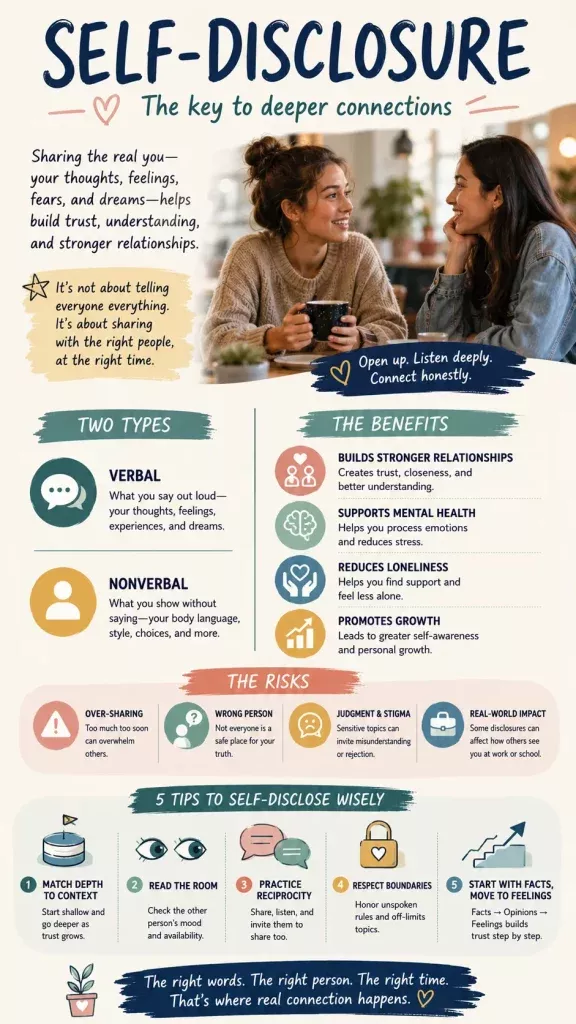
What Is Self-Disclosure? A Clear Definition
At its simplest, self-disclosure means choosing to let someone see the real you. It’s when you share your thoughts, feelings, fears, goals, or experiences instead of keeping them locked away.
Maybe you tell a friend you’re nervous about an exam, admit a mistake, or open up about a dream you’ve never told anyone. That’s self-disclosure.
The important part? It’s a choice. You decide what to share, who to share it with, and how deep you want to go. That’s what makes it different from things people can already see, like your clothes, facial expressions, or the way you talk.
The Two Types of Self-Disclosure
1. Verbal Self-Disclosure
This is the obvious kind: using words to share what’s going on inside your head and heart. Think: “I’ve been feeling stressed lately” or “I really want to become a musician someday.” These honest conversations are often what build trust and stronger friendships.
2. Nonverbal Self-Disclosure
Sometimes you reveal things without saying a word. Your style, tattoos, favorite band shirt, or even the way you carry yourself can tell people something about who you are. It’s like your personality leaving little clues behind.
Most of the magic of relationship-building, though, happens through verbal self-disclosure — those brave moments when you stop hiding and start being real.
Two Key Dimensions: Breadth and Depth
Not all self-disclosure is the same. Psychologists say it grows in two ways:
- Breadth is how many different topics you share with someone.
- Depth is how personal those topics become.
Think of getting to know someone like peeling an onion (hopefully with fewer tears). At first, people share safe stuff: where they’re from, their hobbies, their favorite movies. But as trust grows, they start revealing deeper things — their fears, insecurities, and biggest dreams.
For example, there’s a big difference between saying, “I want to be a doctor” and admitting, “I’m scared I’ll never be good enough to become one.”
This gradual process is actually smart. We don’t hand strangers the keys to our deepest thoughts on day one. We share a little at a time, see how they respond, and build trust before opening up further. That’s how strong relationships are built.
The Johari Window: A Visual Map of Self-Awareness
One of the most enduring models for understanding self-disclosure is the Johari Window, developed by Joseph Luft and Harry Ingham in 1955. The model divides self-knowledge into four quadrants (Social Sci LibreTexts, Self-Disclosure and Interpersonal Communication):
| Quadrant | Description |
| Open/Arena | Information known to you and to others (e.g., your job, your hobbies) |
| Blind Spot | Information others can see about you, but you cannot (e.g., a habit that annoys people) |
| Hidden/Façade | Information you know about yourself but haven’t shared |
| Unknown | Information unknown to both you and others |
Why People Self-Disclose: Motivations and Triggers
People don’t open up for no reason. Usually, they’re hoping to get something valuable from it.
- Personal goals: Maybe they want advice, emotional relief, or just to make sense of what’s going on in their head.
- Connection: Sharing personal things helps people feel closer and less alone.
- Reciprocity: Ever notice how when someone tells you a secret, you suddenly want to share one too? That’s human nature.
- Risk vs. reward: Before opening up, most people silently ask themselves, “Is this worth sharing?”
Of course, not every deep conversation is planned. Sometimes emotions take over, the timing feels right, and the words just come out.
The Science-Backed Benefits of Self-Disclosure
When you share thoughtfully with the right people, some pretty amazing things can happen.
1. Builds Deeper Relationships
Friendships and relationships grow through honest conversations. The more people trust each other and open up, the closer they tend to become. It’s like building a bridge—one personal story at a time.
2. Supports Mental Health and Emotional Processing
Keeping everything bottled up can feel like carrying a backpack full of bricks. Talking about your struggles often makes them feel lighter. Research even shows that expressing difficult experiences can improve emotional well-being and help people process tough feelings.
3. Reduces Loneliness and Isolation
When you’re going through something hard, opening up reminds you that you don’t have to face it alone. Support, understanding, and even a simple “I’ve felt that too” can make a huge difference.
4. Promotes Recovery and Personal Growth
That’s one reason therapy works so well. Talking honestly about your experiences can help you understand yourself better, heal from challenges, and see solutions you couldn’t see before.
The Risks: When Self-Disclosure Goes Wrong
Opening up can bring people closer, but it can also backfire if you’re not careful.
- Sharing too much too soon: Telling someone your entire life story five minutes after meeting them can feel like handing them a 500-page book they didn’t ask for.
- Trusting the wrong person: Not everyone deserves access to your deepest thoughts.
- Fear of judgment: Some topics are especially personal, and unfortunately, not everyone responds with kindness.
- Real-world consequences: In school, work, or other settings, certain disclosures can change how people see you.
The goal isn’t to tell everyone everything. It’s to share the right things with the right people at the right time.
How to Self-Disclose More Effectively: 5 Practical Tips
1. Match the Depth to the Relationship
Don’t skip straight to your biggest secrets. Start small and let trust grow naturally over time.
2. Read the Room
If someone is stressed, distracted, or clearly not listening, it might not be the best moment for a deep conversation.
3. Make It a Two-Way Street
Good conversations aren’t one-person speeches. Share, listen, and give the other person space to open up too.
4. Respect Boundaries
Every friendship, family, or relationship has topics people may find uncomfortable. Pay attention to those boundaries and talk about them openly when needed.
5. Start with Facts, Then Feelings
A simple formula works surprisingly well:
- Facts: “I’ve been working on this for months.”
- Opinions: “I don’t think it’s going very well.”
- Feelings: “Honestly, I’m feeling discouraged.”
Each step builds trust before you reveal something more personal.
Self-Disclosure in the Digital Age
The internet has completely changed how we open up. Today, people share personal stories through social media, group chats, gaming communities, and messaging apps. Sometimes that feels easier because you’re behind a screen and less worried about being judged. But there’s a catch: once something is online, it can be much harder to take back.
Interestingly, research shows that when people share honestly online, even strangers can start liking and trusting each other more. Just remember: hitting “post” is a lot easier than hitting “undo.”
Conclusion: The Art of Authentic Opening
Self-disclosure is how strangers become friends and friends become people you can truly count on. It’s how we share our struggles, celebrate our dreams, and remind ourselves that we’re not alone.
The research is simple: when you open up thoughtfully, listen to others, and build trust step by step, relationships become stronger and life feels a little less heavy.
The real skill isn’t telling everyone everything. It’s knowing when to open up, how much to share, and who has earned the right to hear it. Get those three things right, and you’ll have one of the most powerful relationship skills a person can learn.

- How to Cope With Grief and Loss: A Compassionate Guide – 10/08/2026
- Love Bombing: Signs, Stages, and What to Do – 03/08/2026
- Signs of Anxiety Disorder in Adults You Shouldn’t Ignore – 29/07/2026







Leave a Reply